Summary – A top-down review of interesting calls and comments made last week in Treasuries, monetary policy, economics, stocks, bonds & commodities. TAC is our acronym for Tweets, Articles, & Clips – our basic inputs for this article.
- Editor’s Note: In this series of articles, we include important or interesting Tweets, Articles, Video Clips with our comments. This is an article that expresses our personal opinions about comments made on Television, Tweeter, and in Print. It is NOT intended to provide any investment advice of any type whatsoever. No one should base any investing decisions or conclusions based on anything written in or inferred from this article. Macro Viewpoints & its affiliates expressly disclaim all liability in respect to actions taken based on any or all of the information in this article. Investing is a serious matter and all investment decisions should only be taken after a detailed discussion with your investment advisor and should be subject to your objectives, suitability requirements and risk tolerance.
1.World Changing under our feet & in front of us?
This week we all saw a crack under one of the least important stock markets in the world & a turn in one of the most important non-US bond markets in the world. And that was despite one of the most soothing & bullish events for US Treasuries.
To be candid, we have been seeing signs that what we have ahead resembles to an extent what we saw in October 2007. And on Friday, Treasury yields fell hard on that much lower than expected payrolls number. But by early afternoon, that decline was replaced by a definite move up in every maturity on the 30-1 yr T-curve.
- The Market Ear@themarketear – Oct 3 – France just printed a 16-sigma move. EUR/USD hit its most oversold level since 2015. Rates hit the equity pain threshold. $100 oil is trading with strangely relaxed upside vol. Welcome to the extremes.
And this came on top of Thursday’s big news:
- The Market Ear@themarketear – Oct 1 – One of the world’s biggest structural bond buyers is starting to turn. Japanese money is coming home. The timing for global duration couldn’t be worse.

And guess what happened to European Credit on the same day?
- The Market Ear@themarketear – Oct 1 – European credit is exploding. Vol is spiking. SX5E is sitting on make-or-break support.

What about the homeland? Something broad & deep protects us & hopefully continues to do so:
- Mike Zaccardi, CFA, CMT 🍖 @MikeZaccardi – Oct 2 – BofA: Households aged over 55 held close to $140 trillion in net worth in the second quarter of 2026
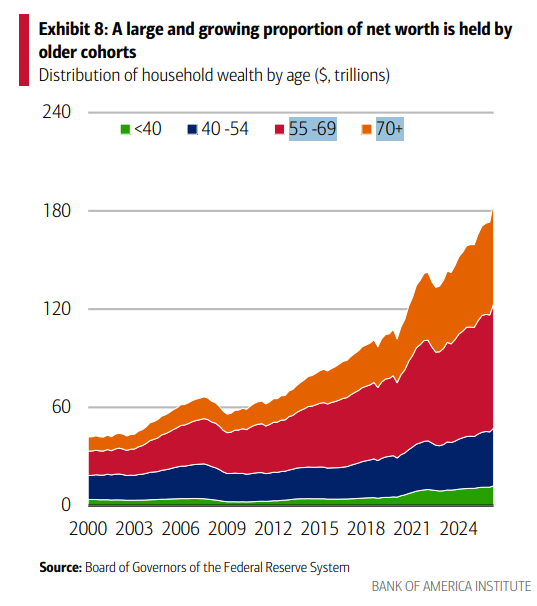
Our guess is that much of this wealth has been thanks to the relentless rally in the Stock market for years & especially since March 2020 & the COVID scare. Having accumulated such wealth mainly by not panic selling US stocks, we don’t think that these households will now turn & begin liquidating! Especially when the wealth might largely be due to one sector?
- Steve Rattner@SteveRattner – Oct 2– The S&P 500 is near a record, but if you strip out the A.I. companies, it’s down 5% since late August.
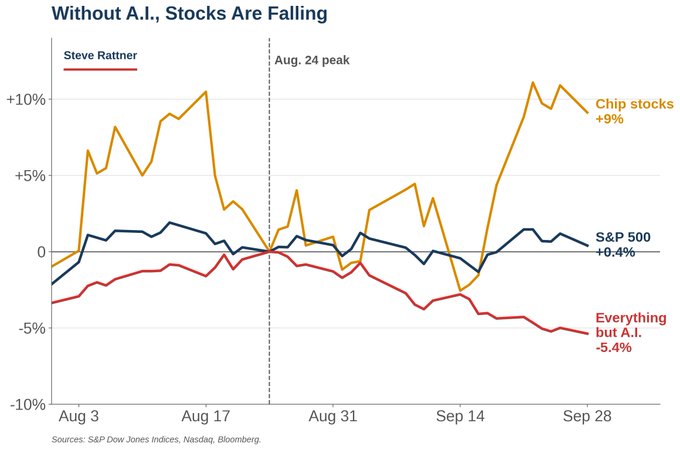
Given how we began this section, some ask if the global stuff is hurting this sector responsible for the wealth of US Households?
- The Market Ear@themarketear – Oct 2 – Everyone is debating whether the AI trade has gone too far. Meanwhile, Taiwan is printing fresh all-time highs, earnings are accelerating and foreign investors are still light. The mother ship is sending a message.
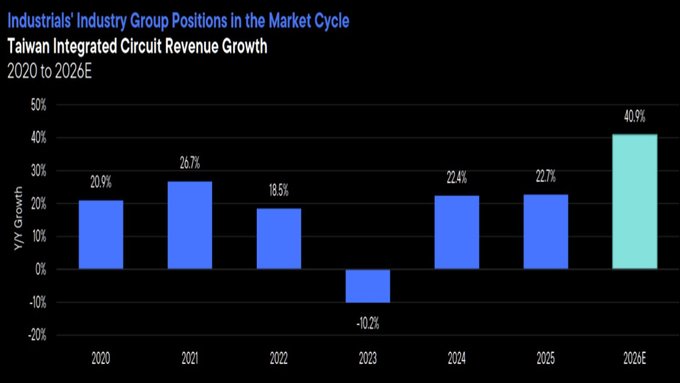
Having said the above, we keep thinking about October 2007 when the stock market made a new high. And, it was October 2007 that began making many concerned about credit weakness. And, as we recall, after the FOMC meeting at the end of October 2007, Treasury rates began responding to credit weakness from November 1, 2007.
Remember what John Kolovos of Macro Risk Advisors said about their Bond Market Financial Conditions model two weeks ago?
- “Bond Market Financial Condition Model is about ready to go into Sell Territory by going above the 50 line. Last time it did so was in 2025 when it was a mini-bear market & before that in 2022 when it was a proper bear market. (It is) very very close to that level right now… “
We wonder if CNBC’s Mike Santoli might be persuaded to bring back John Kolovos on his show this week and get an update on the Bond Market Financial Condition model. Our concern increased when we heard Jeff DeGraff of RenMac express his own misgivings about credit in the section titled Credit Cracks, Breadth Weakens, and the Average Stock Falls Behind at min 9:07 in RenMac weekly exchange of views on Saturday, October 3. A quick & incomplete summary is below:
- “the thing that we still need to watch creep into this are CCC-trades; CCC vs. BB is the heart of where junk lies – now trading at 952 bps… there are 4 issues that are really stretched; they represent about 25% of that market; you take that out & you start to drop that back to 680 bps; impact of all those spreads are starting to go up … I think we have gotten to that point where it is starting to impact the credit market... the impact there on the aggregate demand & the economy and I think we are just at the cusp of that starting to happen … it is an important point for us; credit markets are a little bit of a way to tell what innings we are in in whatever cycle & our market cycle clock is still in a bearish zone but it has been in a bearish zone for months now without any change or inflection in credit ; now we have started to see that inflection in credit – may be saying this is latter innings …. this is one where Fed is – the boot is on the neck here and the question is how hard do they press; we will watch it … European – French & Italian sovereigns are beginning to get unglued a little bit ; you see that in the CDS spread; … ;it will happen there before it happens here.. shld first happen in UK & Japan“
DeGraff is an equity guy as far as we know. That is important because we have seen that when equity guys start worrying about & seeing unwelcome signs in corporate credit, it may be a signal for simpletons like us to begin worrying.
We now wonder whether John Kolovos is also seeing this & hopefully CNBC’s Mike Santoli will share that with us commoner viewers.
And it might help all to recall how rates, credit & stocks began behaving differently in November 2007, perhaps because of FOMC meeting on November 1 or because the damage in credit began becoming clear to stock guys too.
2. Markets Last Week
2.1 US Indices:
- VIX down 1.9% to 15.31; Dow down 1.3%; SPX down 26 bps; RSP down 65 bps; NDX up 65 bps; RUT down 18 bps; MDY up 57 bps; XLU up 81 bps; SMH up 4%; SOXL up 8.1%; NVDA up 4%.
First the truly beaten:
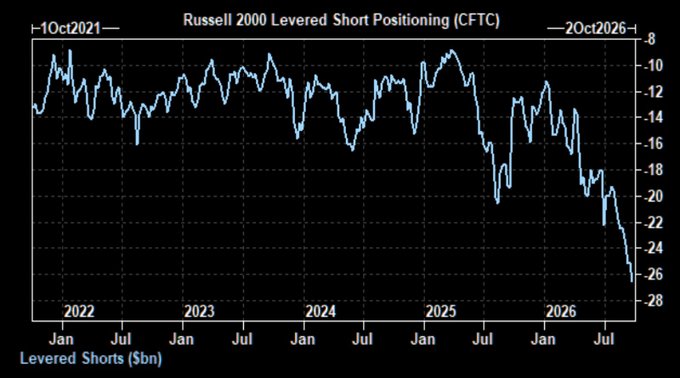
- The Market Ear@themarketear – Oct 2 – Washed-out positioning. Record shorts. Massive support holding. Now imagine what happens if rates finally give Russell some oxygen.
To the next level:
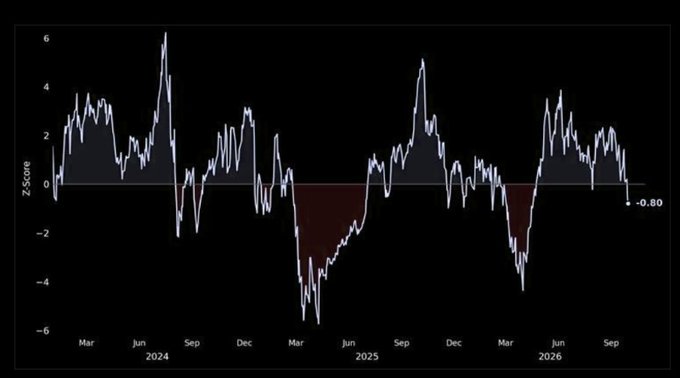
- The Market Ear@themarketear – Oct 2 – NDX is knocking on the door. SOX is breaking out. Positioning has been cleaned up. Buybacks are coming back.
Now to the top:
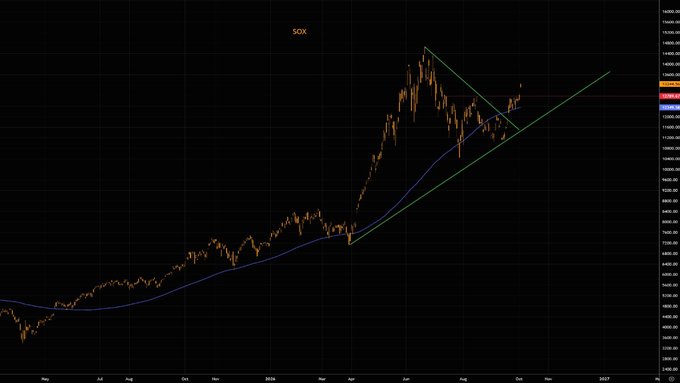
- The Market Ear@themarketear – Oct 2 – SOX is breaking out. Taiwan is still leading. Memory remains brutally tight. And expectations have already been reset.
And now for the downtrodden & left behind:
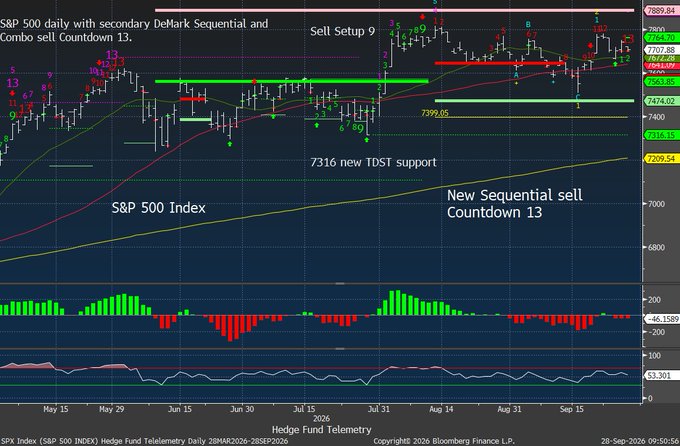
- Thomas Thornton@TommyThornton – 9-28 – $SPX new DeMark Sequential sell Countdown 13, follows recent Nasdaq Composite Sequential sell Countdown 13. As shown on Hedge Fund Telemetry
2.2 MAG 7:
- AAPL down 2.2%; AMZN up 74 bps; GOOGL down 12 bps; META down 3.1%; MSFT up 26 bps; NFLX down 5.7%; SMH up 4%; SOXL up 8.1%; NVDA up 4%; MU down 68 bps; SNDK down 3.3%; IBM down 1.3%; IGV up 2.3%; CRM up 23 bps; PANW up 7.6%; NOW down 91 bps; PLTR down 49 bps;
Since software companies are highlighted in this section, we thought it might the appropriate section in which to include this weekend’s clip by Steve Eisman titled Why Private Equity’s Software Bet Is Going to Zero. The discussion about Private Equity & Private Credit investments in Software & the associated issues that are coming up can be heard from minute 4:20 to minute 18:16 in the clip below.
The most bullish statement in this clip is Eisman’s assertion that the problems in this area are “not big enough to sink the economy“. From his voice to the Almighty’s Ears, we say!
2.3 Key Financials:
- BAC down 5.2%; C down 4.3%; GS down 3.5%; JPM down 3.1%; KRE down 1.1%; EUFN down 4.9%; SCHW down 2.4%; APO down 6.3%; BX down 5.6%; KKR down 6.6%; XHB down 1.7%; ITB down 3.1%; NAIL down 9.2%;
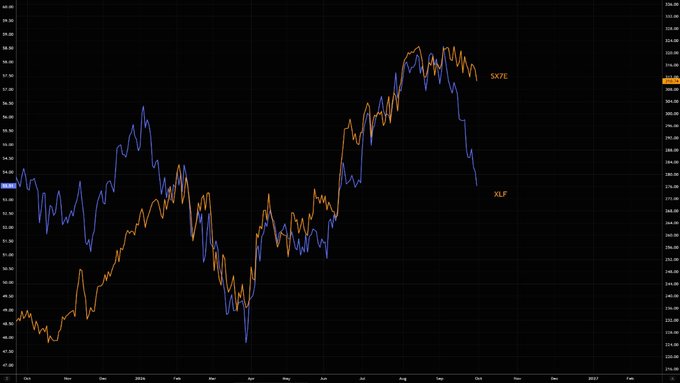
EUFN (European Banks) down as much as US Banks giving credence to the question below?
- The Market Ear@themarketear – Oct 1 – US banks cracked. European banks didn’t. The gap is getting huge. What if Europe is simply late?
2.4 – Dollar & Metals
- UUP up 70 bps; DXY up 61 bps; Gold down 3.2%; GDX down 5.5%; Silver down 5.4%; Copper down 2.9%; CLF down 7.1%; FCX down 37 bps; MOS down 8.4%; Oil down 1%; Brent down 1.5%; OIH down 2.8%; XLE up 1.3%; PBR up 6.3%;
2.5 – International Stocks:
- EEM down 46 bps; EMXC up 14 bps; FXI down 2.3%; KWEB down 2.9%; BABA down 3.5%; EWZ up 3.7%; EWY up 2.5%; EWJ up 1%; EWG down 2.3%; INDA down 2.8%; INDY down 2.3%; EPI down 3%; SMIN down 2.6%; IBN down 1.7%; HDB down 2.9%;
2.6 Treasuries & Interest Rates
- 30-year Treasury yield up 14.2 bps on the week; 20-yr yield up 12.9 bps; 10-yr up 12.1 bps; 7-yr yield up 10.6 bps; 5-yr yield up 8.6 bps; 3-yr yield up 4.6 bps; 2-yr yield down 0.8 bps; 1-yr down 0.8 bps;
- TLT down 2.4%; EDV down 4.8%; ZROZ down 5.1%; HYG down 1.2%; JNK down 1.3%; EMB down 2.2%:
Key question:
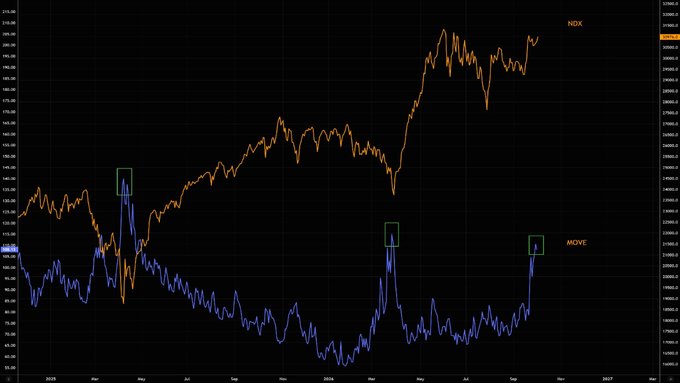
- The Market Ear@themarketear – Oct 2 – Yields surged. Bond vol exploded. Tech refused to break. What happens if both finally reverse?
It makes sense for rates to move up when oil prices do & create higher inflation. But there are times when that correlation doesn’t stand up. Tom McClellan discusses the recent divergence in his article on October 1 titled Crude Oil and Yields Diverging.
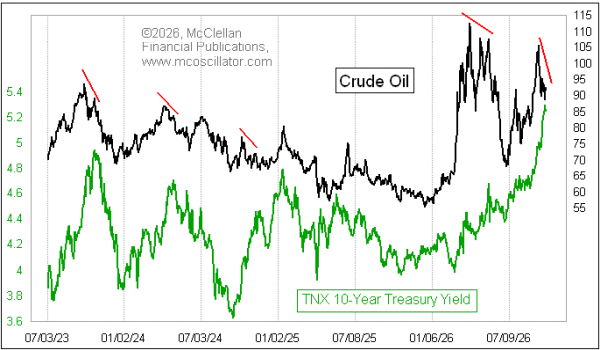
- What is noteworthy right now is that oil prices are not echoing the recent up move during September 2026 in the 10-year T-Note yield. Oil prices peaked on Sep. 15 and fell more than $16 from that high. But the 10-year yield kept on rising during the last half of September, creating the divergence we see at the right end of the chart above.
- History shows that divergences like this are a regular feature of important tops for bond yields. They don’t happen every time, but it is often enough to pay attention, especially when their message is so compelling.
- The drop in oil prices means that we should see a corresponding drop in bond yields to catch up (i.e. down) with what oil prices are already doing. How oil knows better what is coming for bond yields is a fascinating question, but not an essential one. …. Chasing the “why” is far less important than noticing the “is”.
3. Discrepancy but Whose?
Late in the Michigan-Minnesota game, the guy covering the game said there was a “player discrepancy“. He added that the offensive coordinator called for the Michigan Offensive Line to move laterally before snapping the ball. And this coverage guy said Michigan Offensive Line is built & conditioned in Michigan culture to fire out ahead using their size & strength. In contrast, Jason Beck, the offensive coordinator who came from Utah, likes the offensive line to move laterally.
The play misfired & the play-by-play guy called it a “player discrepancy“. Hmm? More like a “coach discrepancy“, we think. In College Football, the line coach HAS to WORK WITH his players who form the offensive line. So his plays & the movements in the play call have to FIT with the players. He can’t bring an Utah play that is based on a smaller mobile offensive line & thrust it on the big Michigan O-line that is built to fire out. The arrogant players-do-what-he-wants order cost Michigan Offense in more than this week’s game. This was backed up by Urban Meyer, (ex-OSU coach & winner of multiple national titles) who said at half-time that the Michigan coaches don’t trust their star player, Bryce Underwood.
We have seen bad coaches, incompetent coaches but we have NEVER seen a new offensive coach come in and essentially tell his players that they are not suitable for his offensive schemes. And we have never seen a head-coach (who was brought out of retirement) to coach a Michigan team with whom he cannot even build a relationship of trust.
Frankly, this is exactly the problem with the Michigan Athletic leadership who seem to want coaches to look good in TV interviews instead of coaches who can work with the players. Just a horrendous state of affairs!
The absolute first step for Michigan is to fire this Offensive coordinator, Jason Beck and find another with Michigan football culture & experience whom the players can respect. And we are not sure that Kyle Whittingham should stay on as coach given his utter & complete inability to even speak with his team.
Whatever you might say about Ohio State but coaches & other officials hired by that team are first & foremost Buckeyes who feel for & understand the OSU culture & tradition.
Finally, as a wild but exciting thought! How about attracting Nick Saban to come to Michigan as the Football Head-Honcho? After all, Saban coached Michigan State & competed against Michigan before going to LSU. And coming to Michigan would not create turmoil among his fans at Alabama & the SEC. And is there any amount of money that CEO Larry Ellison & CEO Steven Ross will not collect to persuade Nick Saban to come back to run football at Michigan?
Remember Nick Saban retired after losing to Michigan inside of retiring with another National Championship. Now he might have the opportunity to win one again this time for Michigan!
And you know who should be lead of the Bring Nick Saban to Big Blue campaign? Another Michigan guy that a few folks would know, Tom Brady!
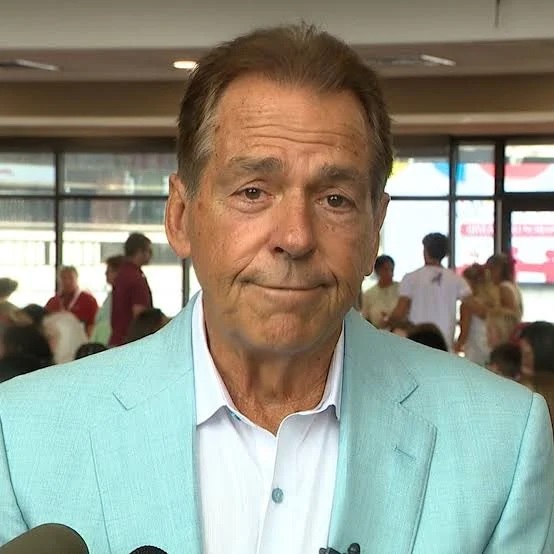

Just think what can’t these two do for Michigan Football! Come on Tom, call Mr. Saban & begin the drive to take Michigan Football to unimagined heights!
Send your feedback to editor.macroviewpoints@gmail.com Or @MacroViewpoints on X.
