Summary – A top-down review of interesting calls and comments made last week in Treasuries, monetary policy, economics, stocks, bonds & commodities. TAC is our acronym for Tweets, Articles, & Clips – our basic inputs for this article.
- Editor’s Note: In this series of articles, we include important or interesting Tweets, Articles, Video Clips with our comments. This is an article that expresses our personal opinions about comments made on Television, Tweeter, and in Print. It is NOT intended to provide any investment advice of any type whatsoever. No one should base any investing decisions or conclusions based on anything written in or inferred from this article. Macro Viewpoints & its affiliates expressly disclaim all liability in respect to actions taken based on any or all of the information in this article. Investing is a serious matter and all investment decisions should only be taken after a detailed discussion with your investment advisor and should be subject to your objectives, suitability requirements and risk tolerance.
1. “Déjà vu all over again“
Those were stunning words from Mr. Christopher Waller, a member of the Fed’s team under Chair Warsh. We don’t know why Mr. Waller made those public comments without mentioning whether his Chair concurred with his idea. Apart from these issues of teamwork, what Mr. Waller said had stunning impact on the markets. As we recall NVDIA had reported earnings & the stock was rallying with other Semiconductors. Within a short time after Mr. Waller’s comments, the rally in NVDIA faded & so did the rally in the stock market.
We saw real similarity between the storm caused in October 2018 from comments from the then Fed Chair Powell and this week’s mess from Mr. Waller. Below are links to our articles from that period that readers might find relevant.
1.1 – September 29-October 5, 2018
- “Seemingly unconcerned about what he was signalling, Chairman Powell said the Fed might have to overshoot beyond what was thought to be neutral rate. That did it.”
What did it do? Thanks to Mike Zaccardi, we all can see it in his chart below of the S&P 500 from October 2018 to January 2019.
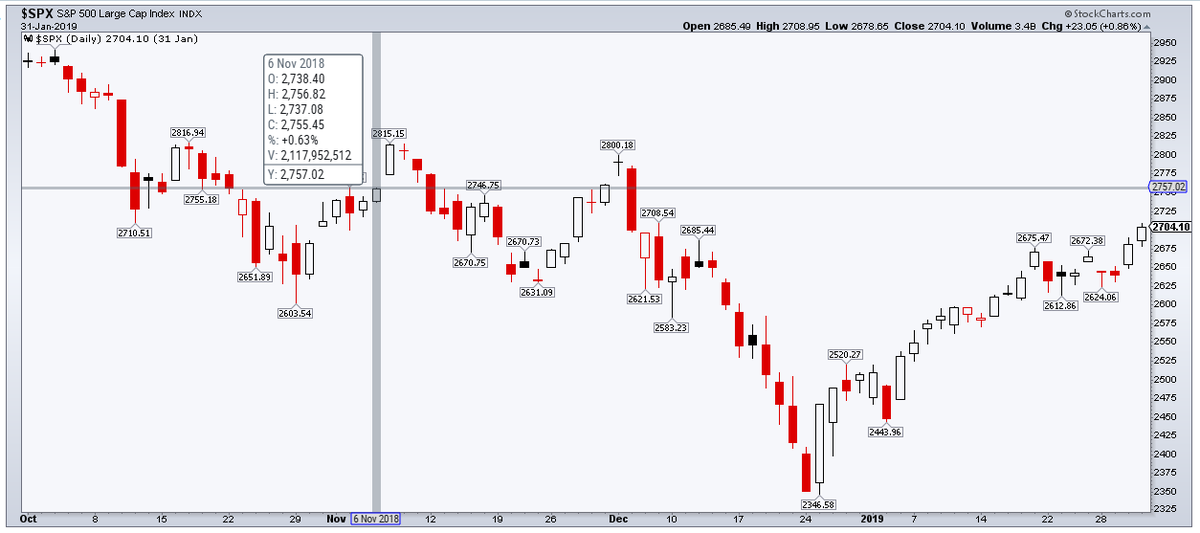
We may be in a repeat of that storm, perhaps an even bigger, faster & more destructive tornado. So it is highly important, in our opinion, to trace the verbal disasters that launched the 2018 storm & kept it going for 3 months. The articles we cite below have comments from several cognoscenti & it might help to read those using the links we provide.
To begin with, there is probably no one like Jim Cramer to speak explicitly, as he did on Friday, October 5, 2018 on his show:
- “That’s exactly what happens when the chairman of the Federal Reserve tells us he may need to overshoot with his rate hikes to ensure inflation is kept in check … It’s going to be hard for stocks to stabilize until he walks back those comments, or at least clarifies that he’s going to make his decisions based on the data rather than giving us a series of lockstep, autopilot rate hikes that the economy, as strong as it is with these employment reports, may not be able to handle“
Cramer added the below in his October 5, 2018 comments:
- “I see housing, autos and now, after this week, maybe even retail slowing, so it’s entirely possible the Fed is ahead of the curve already when it comes to stamping out inflation, … In the end, there’s only so much they can control, and these three industries really tell us that the rate hikes are already working like they’re supposed to.”
Jumping to today, ask how are “housing, autos & even retail” acting today? Strong or weak going to weaker? Is this a case of Déjà vu all over again?
We wrote on October 5, 2018 that “Chairman Powell certainly spoke like a bull & he created a stampede.” But a stampede is narrow in its reach & intensity. The question today is whether Christopher Waller has created a tidal wave across oceans.
Cramer was 100% correct in saying on October 5, 2018 that stocks wouldn’t stabilize until Powell walked back his comments. But it took 3 months for Powell to do so & what did stocks do until that day?
- From October 4, 2018, to December 24, 2018, the S&P 500 fell -18.97% (-550.51 points), dropping from a closing value of 2,901.61 to 2,351.10. Key Period Metrics – October 4, 2018 Close: 2,901.61; December 24, 2018 Close: 2,351.10; Point Change: -550.51; Percentage Change: -18.97% [1]
- … I am very sensitive to not being rigid or pre-determined about the pace at which we get there (to neutral rate) and the reason is again, I expect GDP growth in 2018 to be strong but I expect it to to moderate in 19 & 20 as this fiscal stimulus starts to wane …. getting the balance right for me is going to require an open mind & to not be pre-determined or prejudge … “
- (((The Daily Shot))) @SoberLook Chart (
@TheTerminal): US market-based inflation expectations are moving lower with crude oil –
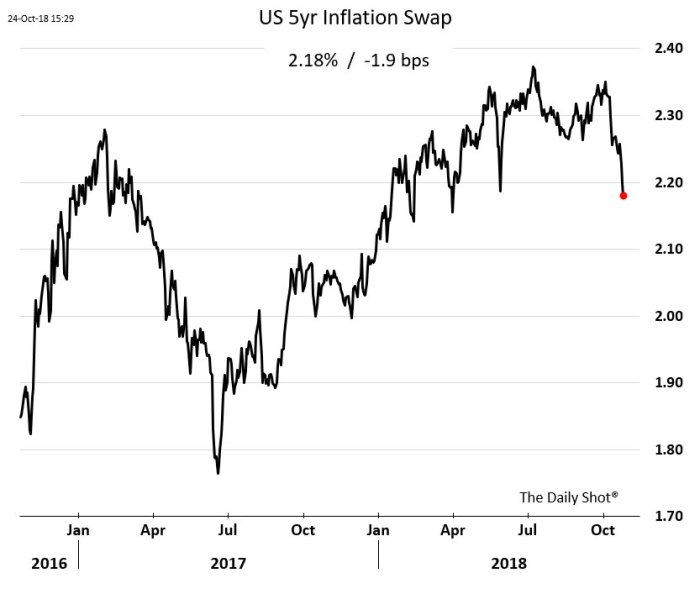
And that week, Treasury yields fell hard, as we wrote then:
- The 5-year yield has fallen by 16 bps from 3.07% to 2.91%, the 10-year yield by 15 bps from 3.23% to 3.08% and the 30-year yield by 8 bps from 3.40% to 3.32%. Both the 5-year & the 10-year yields broke to a weekly close below important levels of 3% and Santelli’s 3.10-3.11% resp.
That sort of instability persisted till the Fed meeting on December 18-19, 2018, or “le deluge” based on the screaming it caused or as the Zaccardi chart shows the red waterfall in his chart above.
1.3 December 15 – December 21, 2018 – “Make this guy stop talking”
Make this guy stop talking – was the reaction of traders as described by CNBC’s Sara Eisen to what Powell was saying:
- “The market virtually puked & kept puking at the sight & sound of Chairman Powell talking about their models & uttering tone-deaf statements like balance sheet contraction will remain on autopilot & that Fed policy doesn’t have to remain accommodative at this stage. It was as if the stock market was running away from that spectacle.”
The chart we used then shows the 1st downdraft with the Fed statement & then the larger fall as Powell began speaking.
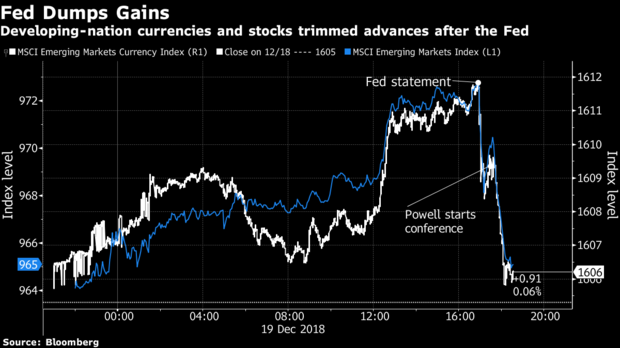
As we wrote then,
- Chairman Powell was crystal clear in his press conference that the balance sheet contraction will remain on auto-pilot. That was destructive to markets and what followed was sheer liquidation. …. But that wasn’t the worst of it. That came on Friday.
So bad that CNBC’s Scott Wapner uttered the plaintive cry “what is the catalyst to stop the selling” in his Friday CNBC Half Time show”.
For David Rosenberg, the central problem was “the “L” word, the growing loss of market liquidity that has been the root cause of the heightened volatility“. And Stephanie Pomboy said on Fox Business:
- “I think worrying about inflation is a great waste of time in an economy as leveraged as ours is; the tendency is deflation, not inflation; that’s going to be the problem here“
The above two comments are instructive for the deluge of selling we went thru in the past 3 days of this week after Waller’s “asinine” comments (the word describes our own truly felt our anger & contempt).
1.4 December 29, 2018 – January 4, 2019 – “today they bent the knee”
As we wrote then:
- “What a perfectly succinct phrase from Josh Brown, a CNBC Half Time trader! That is exactly what Fed Chairman Powell did before markets. It was evident that he was seriously shaken by the fury of the financial markets & the criticism that was directed against him after the December FOMC meeting. That is why he needed previous Fed Chairs, Yellen & Bernanke, with him on stage to give him support.”
- “But that was not enough. He had been so rattled by the carnage created due to his “autopilot” remark during his FOMC presser that he did not want to make any mistake of communication on Friday. So he brought notes and basically read off his notes.”
Kudos to Powell. He did end his ghastly mistake & created a rally that was better then the sell off.
- From January 7, 2019 (the first trading point after Saturday, January 5, 2019) to December 31, 2019, the S&P 500 rose by +681.09 points (+26.71%), moving from 2,549.69 to 3,230.78. (Measured through December 30, 2019 at 3,221.29, the gain was +671.60 points, or +26.34%.) [1]
It is important to summarize that “huge shift in policy Powell enunciated on Friday – muted inflation; not only were further rate hikes data-dependent but their precious balance sheet normalization could also be put on hold if needed“.
2. Markets Last week
We have gone thru a horrendous decline in stocks including market-leading stocks like NVDIA & Semiconductors. The decline reached an almost crazy fury in the past 25 minutes or so on Friday, November 20. It was as if investors were desperate to buy puts or sell stocks before the weekend because no one has forgotten that similar action was seen on Friday October 16, 1987 before that crash on Monday, October 19, 1987.
Obviously it can go both ways on Monday, November 23, 2026. Either natural buyers or the rumored plunge-protection teams would be activated Monday morning OR the selling would begin again in frenzy.
What we do know is that Treasury Bonds rallied hard last week and no one (yet) is lining up to Sell Treasury Bonds. Given the safety & primacy of Treasury Bonds in this scenario, it seems more appropriate to begin this section with Treasury Bonds.
2.6 Treasuries & Interest Rates
- 30-year Treasury yield down 16.3 bps on the week; 20-yr yield down 16.6 bps; 10-yr down 22.4 bps; 7-yr yield down 24.9 bps; 5-yr yield down 25.7 bps; 3-yr yield down 26.3 bps; 2-yr yield down 23.8 bps; 1-yr down 12.7 bps;
- TLT up 2.7%; EDV up 3.4%; ZROZ up 4.1%; TMF up 7.6%; HYG down 79 bps; JNK down 84 bps; EMB down 1.3%;
With interest rates down already, why aren’t Credit ETFs up? We sincerely hope that Credit is not the next sphere to be affected by the fear of what Waller promised.
Weak or weakening growth is usually positive for Treasury Bonds while being non-positive for Credit. In that scenario, could Fed’s rate hikes benefit deflationary forces?
- Otavio (Tavi) Costa@TaviCosta – 11-21 – If you wanted to engineer a deflationary bust like 2008, you’d start by doing exactly what this Fed is doing now. Accelerating rate hikes into a slowing economy that depends entirely on easy money. And here is the irony… They’re fighting inflation by cutting off the investment needed to increase natural resource supply, worsening the very problem at the root of inflation. http://tavicosta.substack.com/p/feds-suicidal-mission
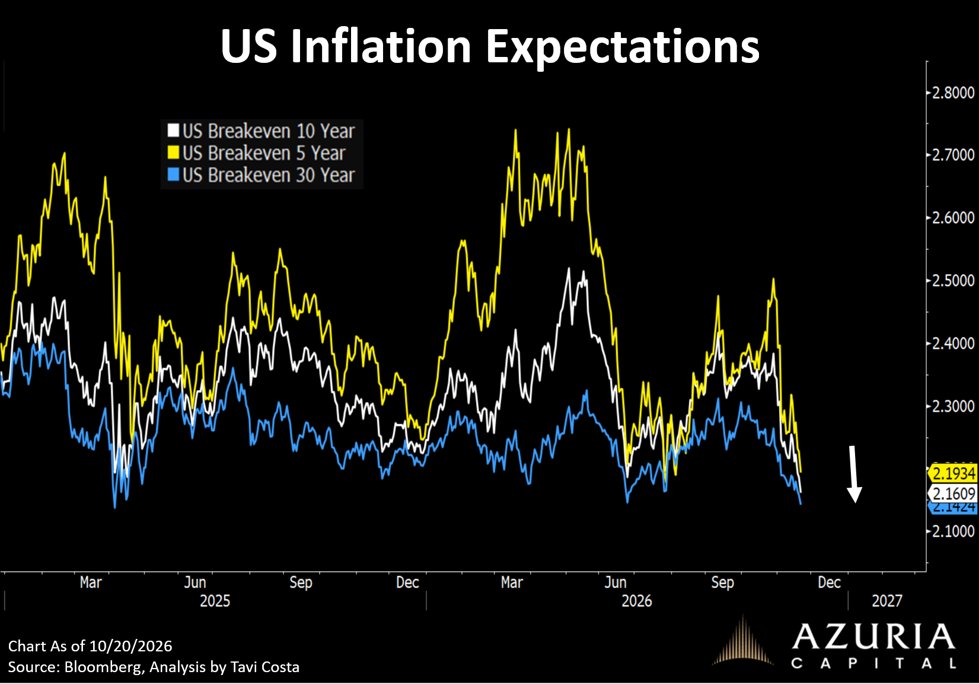
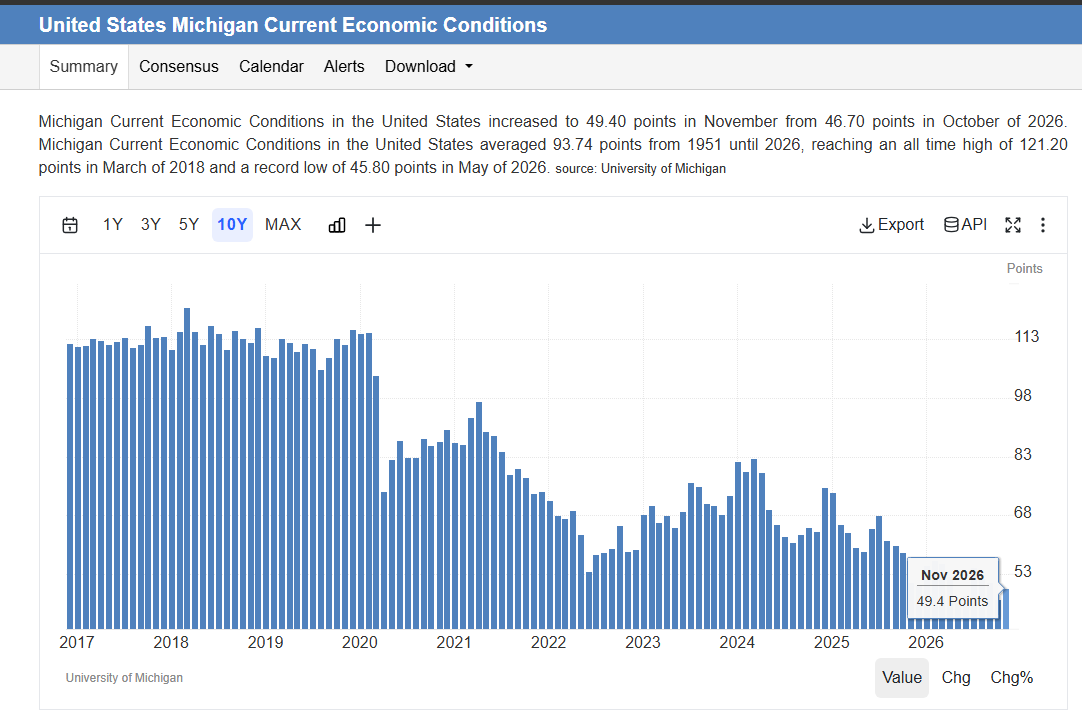
But is this a slowing economy?
- Mike Zaccardi, CFA, CMT@MikeZaccardi – 11-20 – UMich Current Economic Conditions 49.4 – 4th lowest in the survey (which dates back to the mid-20th century)
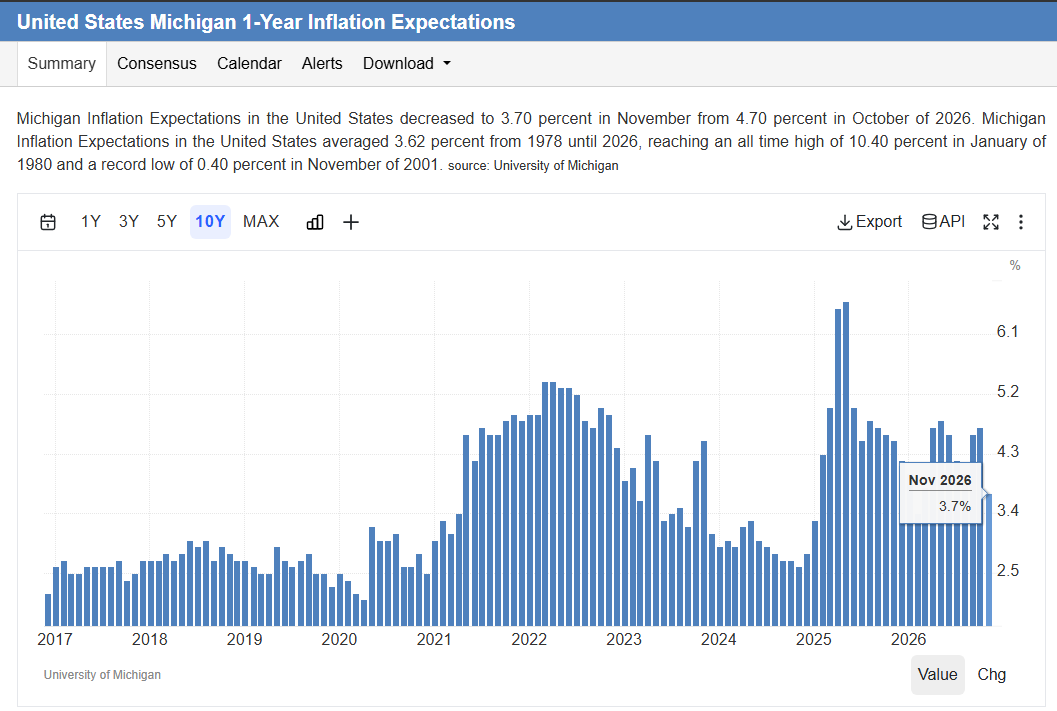
And inflation expectations?
- Mike Zaccardi, CFA, CMT @MikeZaccardi – 11-20 – UMich 1yr inflation expectations 3.7% – biggest sequential drop since June 2025
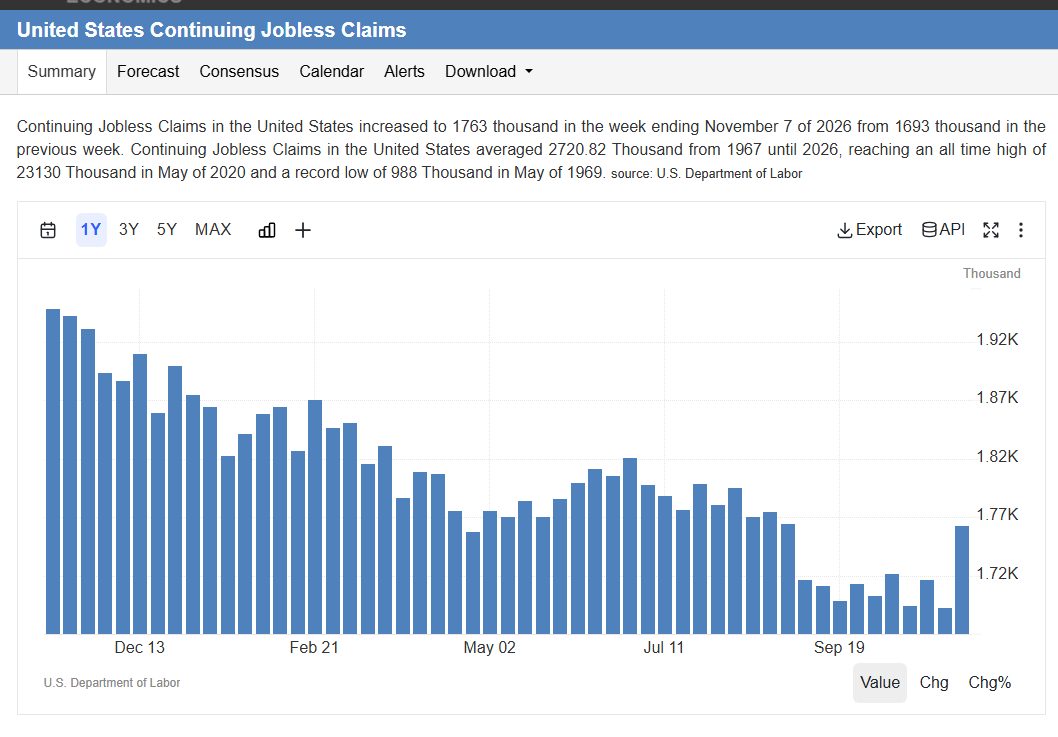
What about employment claims?
- Mike Zaccardi, CFA, CMT @MikeZaccardi – 11-19 – Continuing Claims jumps by the most since January 2024… 1.763 million
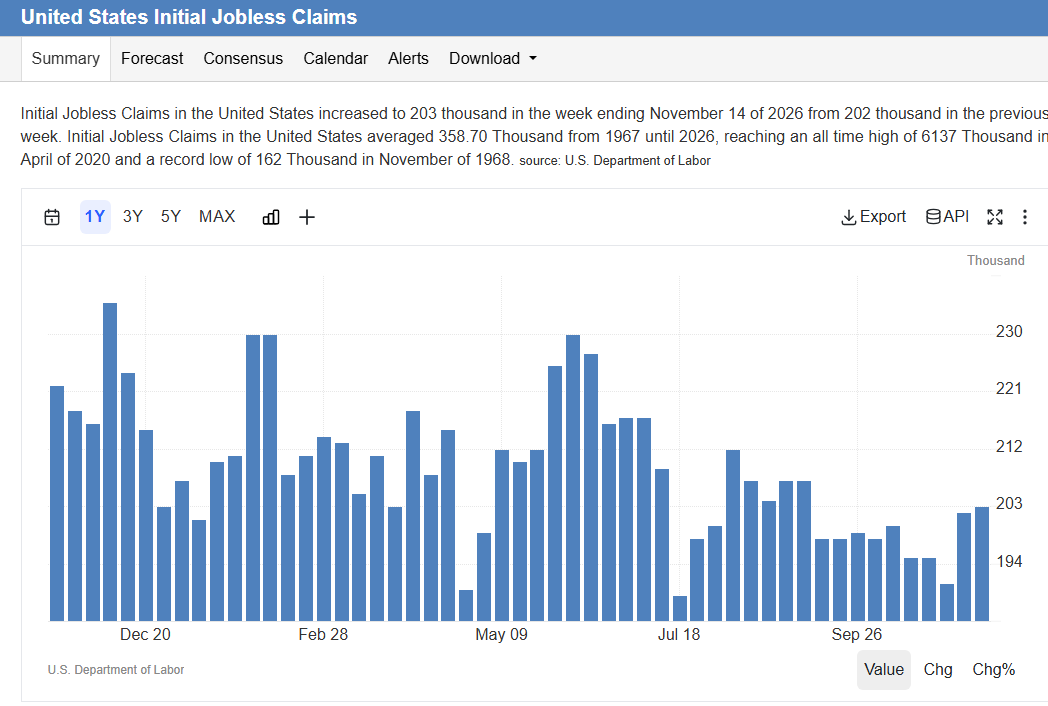
And,
- Mike Zaccardi, CFA, CMT@MikeZaccardi – 11-19 – Initial Claims jump 1k w/w… a big move… 203k
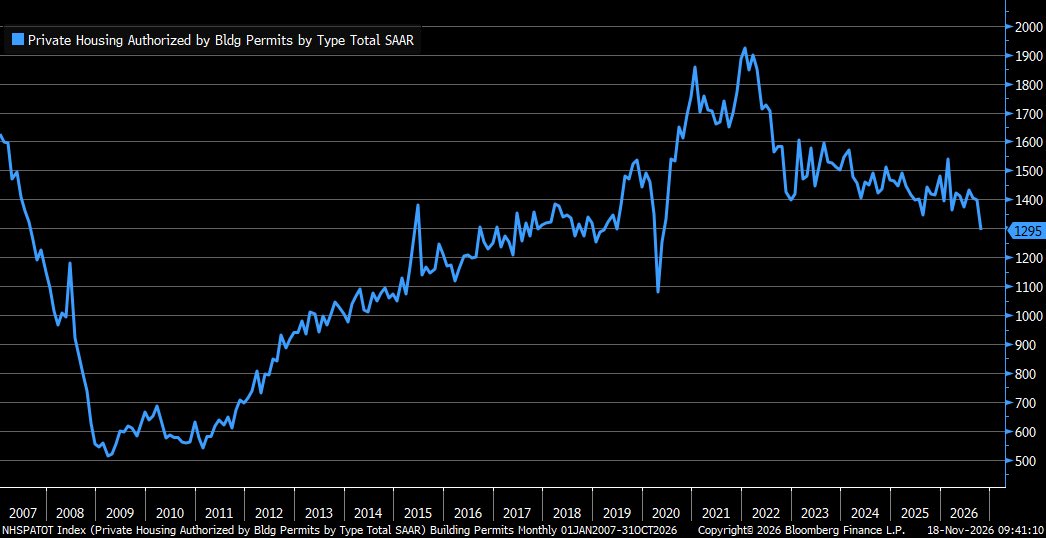
What about housing & construction?
- Liz Ann Sonders@LizAnnSonders – 11-19 – October building permits dropped to their weakest level since the pandemic
And,
- Charlie Bilello@charliebilello – US homebuilder confidence has plunged to its lowest level since 2012. A record 46% of builders are cutting prices and a record 68% are offering incentives (20th straight month above 60%). The problem? Buyers simply can’t afford the homes being built.
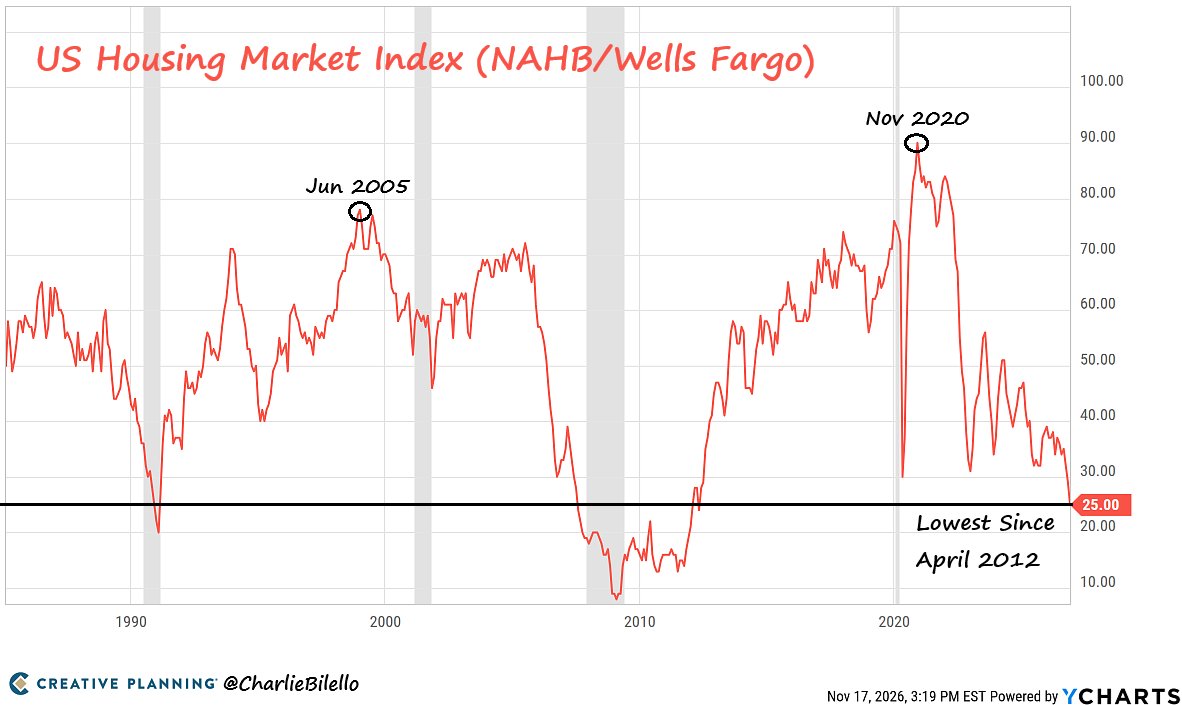
And this is the environment in which Signor Waller wants to raise interest rates to shock (or did he really mean punish) people! With respect for him & his colleagues, does he hate his countrymen so much or he thinks, like some extreme religious sects, people need to be feel intense pain first before they get the rewards much later?
Given all of the above, we wondered what a highly respected investor like Felix Zulauf is saying?
Zulauf said:
- “next year credit demand will slow down; … see oil prices coming down … he expects oil will decline to $60 which means lower inflation next year ; .. commodity prices will decline with the slowing of the world economy … China is not performing very well & it is the largest consumer of commodities ; so all of that will feed into lower inflation rates … and if the stock market declines as I expect… then all of a sudden central banks will come in and they will go into QE & they will create all the liquidity necessary & they will buy government bonds; they will be a large buyer & they will create a steep yield curve … we could see 150-200 bps in Treasuries – 10-yr & 30-yr ; and 10yr Bunds .. It is a big decline that I am expecting – this is the 1st counter-move in the secular uptrend of inflation & bond yields …. its just a trade for 12 months not an investment for a few years ….”
2.1 US Indices:
- VIX up 91.9%; Dow down 8%; SPX down 8.6%; RSP down 6.2%; NDX down 10.4%; RUT down 7.5%; MDY down 6.9%; XLU down 3.1%; SMH down 17.8%; SOXL down 47.1%; NVDA down 22.9%
Don’t think Signor Waller knew it, but he dropped his verbal bombshell in the morning that was busy with expiration of VIX options! Does he even know what VIX is, we honestly wonder. So think about it, the he dropped his verbal bomb at the same time stock traders were busy with NVDA earnings & VIX traders were busy with options expiration!!
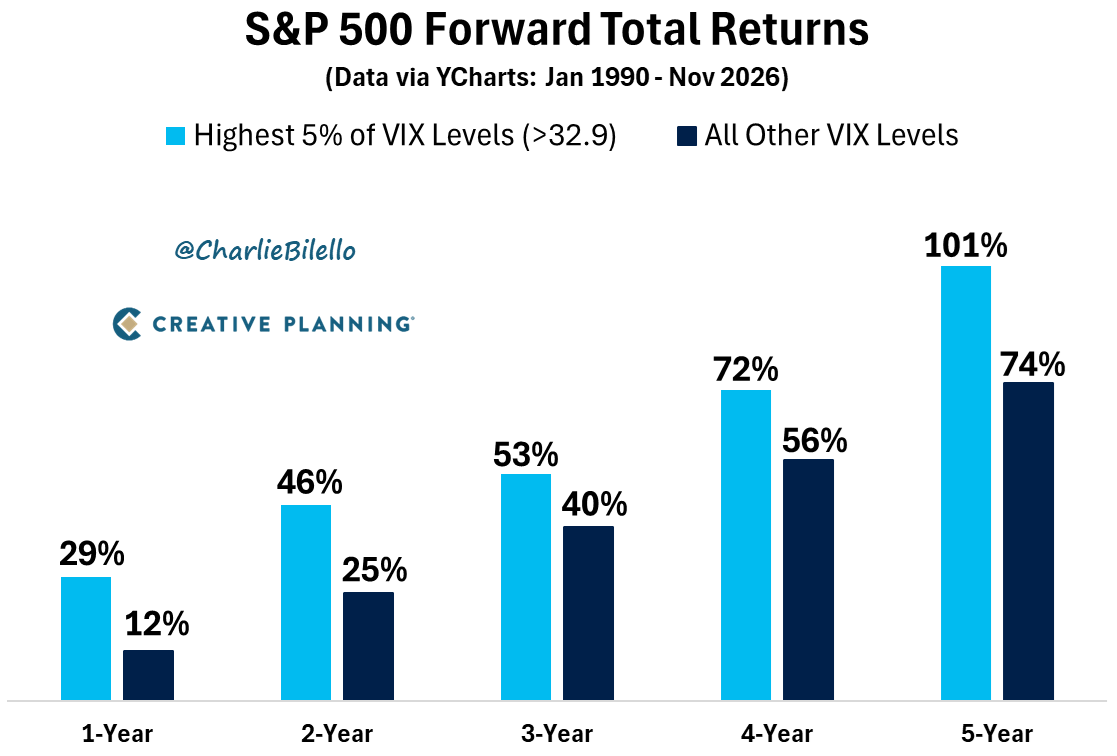
After the VIX reaches it top for this wave, then the following might work well:
- Charlie Bilello@charliebilello – Nov 20 – The $VIX ended the day above 35, its highest close since April 2025. That’s in the top 5% of data points for the “fear index” going back to 1990. Historically, the stock market has posted above-average forward returns following the highest $VIX levels. Fear is good.
Another view in a similar vein:
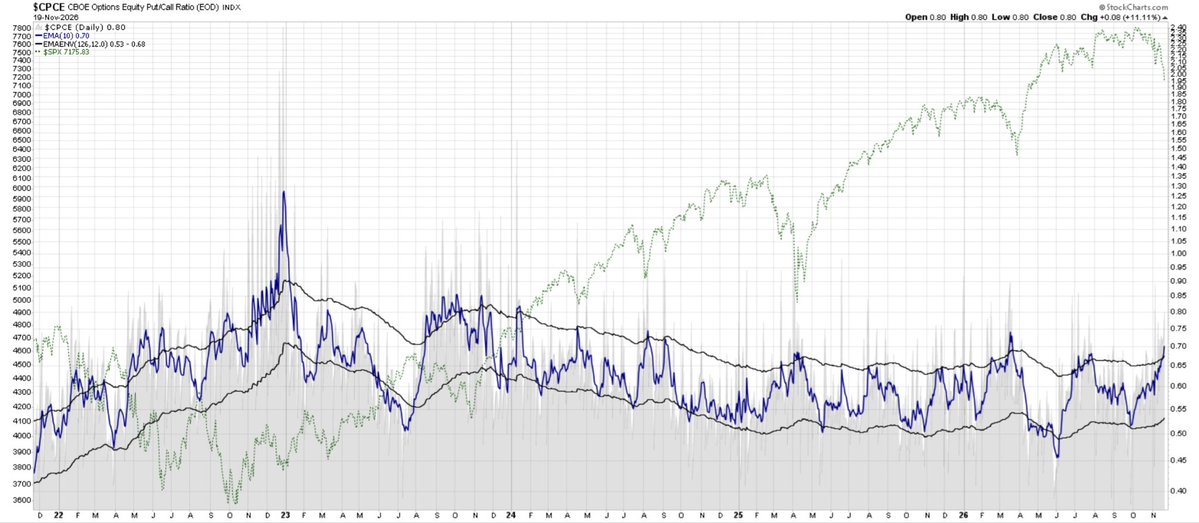
- Bill Luby @VIXandMore – 11-20 – My preferred put-to-call ratio data uses the @CBOE equity-only put-to-call data and is known as the $CPCE. Note that I use relative rather than absolute levels as signals, along with 10-day smoothing, and that today’s level is the 2nd biggest contrarian bull signal since 2023
2.2 MAGs:
- AAPL down 3.9%; AMZN down 7.4%; GOOGL down 10.3%; META down 12.6%; MSFT down 7.5%; NFLX down 8.7%; SMH down 17.8%; SOXL down 47.1%; AVGO down 12.3%; AMD down 20.5%; TSM down 20.1% ; NVDA down 22.9%; MU down 28.6%; SNDK down 28.4%; IBM down 9.2% ; IGV down 9.4%; CRM down 17.1%; PANW up 6.5%; NOW down 14.3%; PLTR down 14.6%;
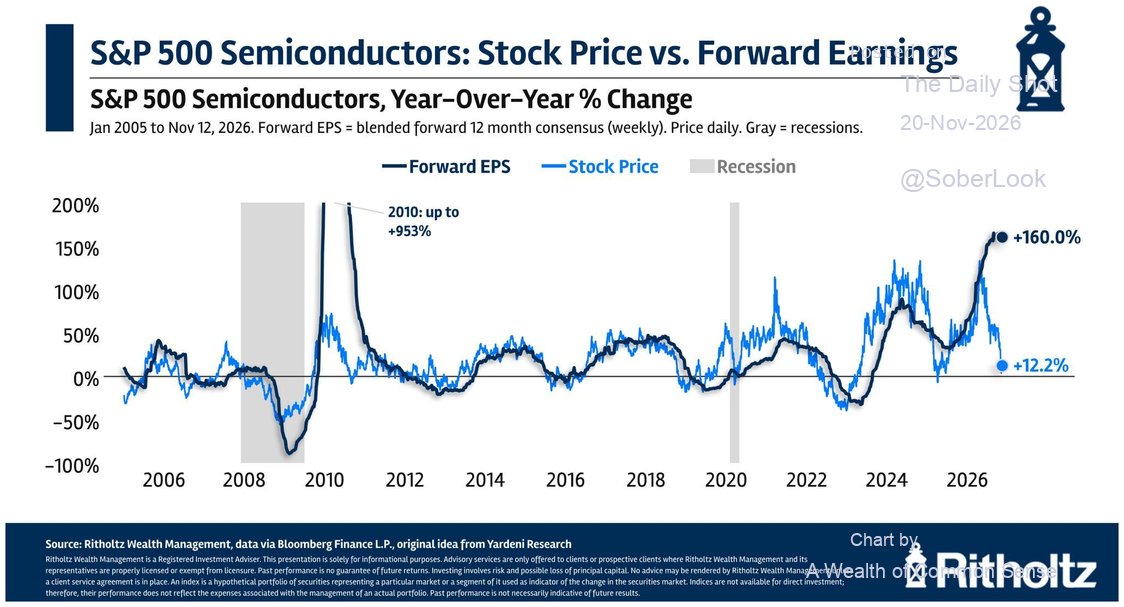
After a horrible week in & for Semis, can any one suggest any good news?
- (((The Daily Shot))) @SoberLook – Semiconductor share prices have diverged from earnings growth. Source: @RitholtzWealth
2.3 Key Financials:
- BAC down 7.8%; C down 10.8%; GS down 13.7%; JPM down 10.3%; KRE down 6.1%; EUFN down 7.7%; SCHW down 3%; APO down 10%; BX down 7.8% ; KKR down 9.7%; XHB down 5.4%; ITB down 3%; NAIL down 9.1%;
Does the action in Bank stocks suggest anything bothersome in Credit? And imagine home-building ETFs going down hard with interest rates melting down? Regarding housing, someone used the following expressions:
- “Buyers at a record low. Sellers outnumber them by more than 70%. … This is a housing crash in activity before it becomes a crash in prices. … Americans are disappearing from the housing market … And as buyers disappear, what that means is it won’t take a mortgage crisis for the housing market to break. It may only take time.”
2.4 – Dollar & Metals
- UUP up 41 bps; DXY up 46 bps; Gold down 9.1%; GDX down 16.2%; Silver down 16.1%; Copper down 10.2%; CLF down 15.7%; FCX down 22.4%; MOS down 14.9%; Oil down 5.4%; Brent down 3.2%; OIH down 12.2%; XLE down 6.9%; PBR down 12.7%;
Does any other section proclaim a softening of the global economy as the above does? And it is also the result of investors running away from copper, metals & oil as they become afraid of a slower global economy. And is Gold down because monies are flying back to the sovereign safety of America?
2.5 – International Stocks:
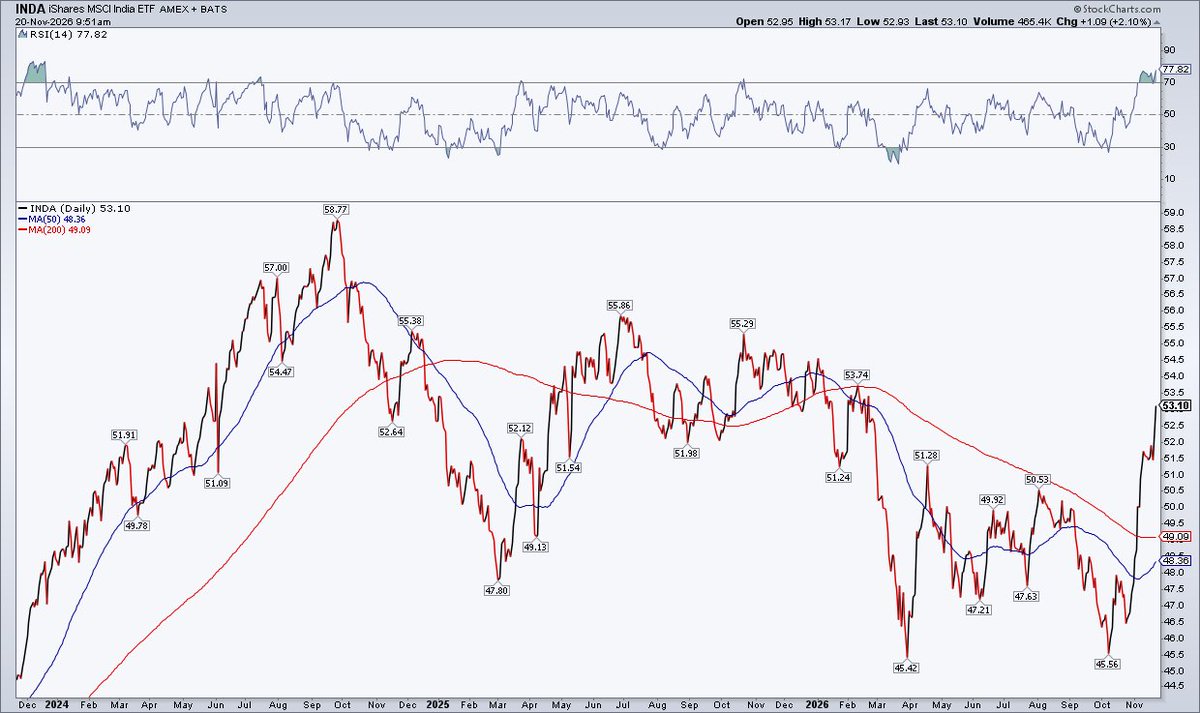
- EEM down 11.6%; EMXC down 12.9%; FXI down 6.7%; KWEB down 9.6%; BABA down 14.1%; MCHI down 7.2%; EWZ down 11.4%; EWY down 13.7%; EWJ down 9.1%; EWG down 8.7%; INDA up 2.8%; INDY up 3.6%; EPI up 2.8%; SMIN up 87 bps; IBN up 2.8%; HDB up 6.2%; NSE up 11.6%.
For most of this year, India was ignored or even sold off because the Indian market did not contain any major players in AI. And global investors were solely focused on AI related entities. But Indian market has been in a bull run since the 1st week of October. Secondly, the Indian Companies are not anti-AI. They are interested in being larger players in the applicability of AI. They want to emulate their success in free & transparent money movement without using SWIFT or without needing Visa & Master Charge. And NSE is the National Stock Exchange in India, listed in September 2026. When monies are pouring into yr country, what stock even simple folks buy? – Stock of NSE – the National Stock Exchange, of course.
Also India is putting large resources in the Indian Ocean near the Indian coastline for oil exploration and recent results seem promising. Many in US might recall how people used write & look forward to days when US would be self-sufficient in Oil. We saw it happen & it has been phenomenal for us. No one should be surprised if that discussion gets more mainstream. about India.
We heard a discussion about Chinese stocks (BABA, KWEB & other favorites) on CNBC Fast Money. This has been the most favorite non-US market for Melissa Lee & her CNBC Fast Money team. Based on that discussion, we looked up 10-year charts of not just these Chinese tech names but even broad funds like MCHI, ASHR. We were stunned at the miniscule returns over 10 years.
On the other hand, we guess Melissa & her team probably have not even heard of India, not at least in any positive context. Triple on the other hand, Melissa can send us a bottle of her favorite Single Malt & we will freely help her in every way with India, Indian markets & why they work. In the meantime, she can view a young Chinese lady dancing to a Hindi Bollywood song:
To migrate from song & dance to plain stock chart:
- Mike Zaccardi, CFA, CMT @MikeZaccardi – 11-20 – India – $INDA – ripping
And,
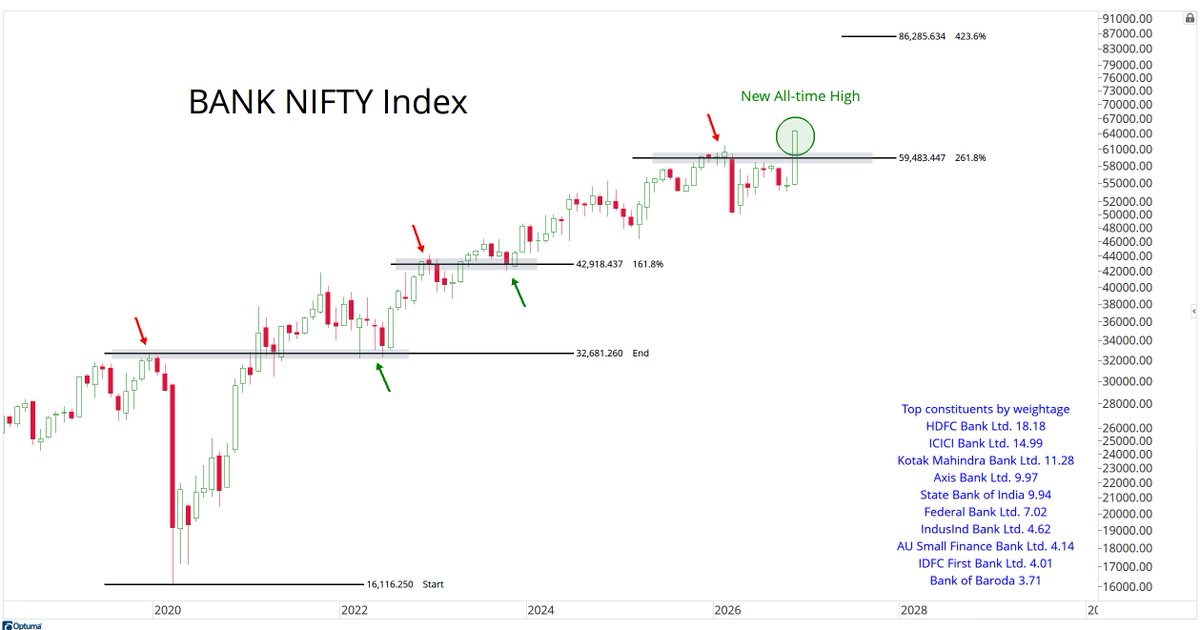
- J.C. Parets@JC_ParetsX – Indian banks are ripping. New all-time highs again this week.
3. Finally they listened
They being the Michigan officials who rule & hire-fire coaches. Michigan’s football began unravelling from its first Big Ten game creating intense unhappiness. The solution was so simple that no one except the Michigan officials could fail to see it. So we wrote on October 4:
- “The absolute first step for Michigan is to fire this Offensive coordinator, Jason Beck and find another with Michigan football culture & experience whom the players can respect”
We saw in stunned surprise that they did so just in time to play Undefeated (No. 4 ranked) UCLA team. It was a pure Michigan offense and defense was classic as usual. Quarterback Underwood was reinstated as THE QB. It was a delight to watch a truly Michigan game and how did it end?
It was an intense game and finally Michigan beat unbeaten UCLA team ranked 4th in the nation. Oh, what joy! Now imagine if Michigan goes to Columbus & beats Ohio State!!! Oh Man! Oh Man! & a triple Oh Man!
Send your feedback to editor.macroviewpoints@gmail.com Or @MacroViewpoints on X.
