Summary – A top-down review of interesting calls and comments made last week in Treasuries, monetary policy, economics, stocks, bonds & commodities. TAC is our acronym for Tweets, Articles, & Clips – our basic inputs for this article.
- Editor’s Note: In this series of articles, we include important or interesting Tweets, Articles, Video Clips with our comments. This is an article that expresses our personal opinions about comments made on Television, Tweeter, and in Print. It is NOT intended to provide any investment advice of any type whatsoever. No one should base any investing decisions or conclusions based on anything written in or inferred from this article. Macro Viewpoints & its affiliates expressly disclaim all liability in respect to actions taken based on any or all of the information in this article. Investing is a serious matter and all investment decisions should only be taken after a detailed discussion with your investment advisor and should be subject to your objectives, suitability requirements and risk tolerance.
1.”scared stiff” and/or “losing our degrees of freedom?’
There was a lot of noise among the economic “elite” after the press conference by Fed Chair Warsh about his committee’s decision to keep the Federal Funds Rate unchanged. A smart question cut thru the noise, a “sotto auris” question by Blomberg’s Tom Keene:
- “are we scared stiff of raising rates because of fear that they might have to reverse? …. are we losing our degrees of freedom?“
We never know what Signor Keene is trying to say and we didn’t quite understand what he meant by “they”. Was he bemoaning losing the ability of the Fed to raise rates at will or, was he moving towards simple folk like us & suggesting that any rate hike might have to be reversed soon & that would be embarrassing.
Our own pre-FOMC suggestion to Chair Warsh, as posted last week, was way at the other end.
- “Come on Fed – feel for the average American family! Reverse the 25 bps hike you forced on us just over a month ago. And lead Western Europe by example by lowering the Fed Funds rate by 25 bps on Wednesday. “
Yes, we were playing to our own very sparsely populated gallery! We knew that Chair Warsh might be lynched if he tried to get thru a 25 bps rate cut! But did the Treasury market concur with us after the FOMC? Think we have all been bombarded by Fin TV saying Treasury yields would shoot up if the Fed doesn’t demonstrate their will & power to raise rates! So, by that logic, Treasury yields should have risen hard & tall after Chair Warsh & his FOMC refused to raise rates and refused to say when they might do so. Instead Treasury yields fell hard across the curve both on Thursday & Friday. So did the Treasury market approve of the Fed’s smart, sensible decision?
Our own reason for asking the Fed to lower rates was simple! As we wrote last week,
- “Our serious fear is that the Powell Fed may have morphed the US economy into that path and the Warsh Fed may not have the ability to change it in time. …. In our humble opinion, the next few months might see events that appear to look like inflationary growth but are actually signs of a global slowdown, if not a recession, ahead. “
This has been our fear since the early summer and sadly none of the richly rewarded economists at Financial firms have concurred with us. We are not surprised because the chorus from this club of rich economists was the absolute necessity to raise rates. Those yahoos (after our favorite song) didn’t notice that:
- the last up week in Treasury yields ended on October 2. Treasury yields ratcheted up that week with 30-yr yield up 14 bps to 5.63% & the 10-yr yield up to 5.28%.
and that,
- every week after that has seen Treasury yields across the curve falling with the big weekly fall coming 2 weeks ago – with the 30-yr & 20-yr yields down 17 bps; 10-yr yld down 16 bps & the 5-year down 14 bps.
We noticed one big change this week, notably on Thursday & Friday. The rally during the previous three weeks had been concentrated in the longer maturities but this week the largest fall in Treasury yields was in the 2-5 yr belly of the Treasury curve. Was the 2-5 yr maturities simply catching up with the longer durations Or was that a signal that the Fed hikes are being taken off the table?
We also noticed that entire finance TV discussion was focused on Google, Amazon & AI and the fall in Treasury yields was almost ignored. That was strange because the failure of expectations in hyperscalars was not a one-day event but an event for this quarter. Remember that the summer was hailed as strong technology period and the steady rise in Treasury yields, especially in long duration yields, was deemed as a natural consequence of the strength in tech sector. No one even dared mention that a hard rise in long-duration Treasury yields has almost always proved to be a constraint and/or a warning for earnings growth in technology stocks. How well this old rule work late this past week? Horribly horribly well, that adjective signifying the serious capital loss for all equity investors?
This was similar, we felt, to the same conviction in the summer of 2007 when Treasury yields kept rising as commodity stocks kept rallying. The S&P went to a new all-time high in October 2007 and the mood leading up to the FOMC meeting on November 1, 2007 was bullish. Then le deluge!
Frankly, we saw the same pattern repeat last week with the new all-time high in October 2026 being followed by a waterfall decline in Treasury yields & steep losses in the most beloved of stocks.
Kudos to BlackRock for Upgrading Short-Term Treasuries and Downgrading U.S. Equities to Neutral, about a week & half ago. And to CNBC for a series of Buy Treasuries recommendations two weeks or so ago.
Since this section so far has been about looking back, how about another look but to a different period! Many would remember that there was a financial crisis of sorts in Europe about 15 yrs ago that led to a new regime, a Europe-wide currency. The various countries in Western Europe went thru a near recession. During that time, we were fortunate to watch an on-air debate (on CNBC as we seem to recall) between two old colleagues – Richard Bernstein and David Rosenberg. Then Bernstein was confident and almost adamant that the US economy and the US stock market would not be affected much by the turmoil in Europe. In contrast, Rosenberg pointed out that the US economy and the European economies are closely linked and the US market has rarely done well when Western Europe is in a near recession. As we recall, Rosenberg turned out to be correct. We would love to see Round II of this debate if the two agree & if a Financial network chooses to hold it.
That brings us to the sister continent of America. Europe seems to be in the news at least in non-Finance TV. This week the wealthy, prosperous nation of Germany saw extreme protests and their main anger was economic at its core. In other words, Germany followed France, Italy et al.
We have not seen or heard on Fin TV any concern about how the economic retrenchment in a huge economy like Europe’s affects the US Economy. The US has the same concerns – wealth of retirees near all-time high while the youth can’t find jobs or only find jobs that offer compensation that is inadequate for housing, progress or even food. The US, however, is a much better supportive economy unlike today’s Europe.
Unlike America, Europe is a hastily put-together jumble of national economies without real economic integration. Worse of all, Europe’s economy is run by an un-elected EU, by a Monetary System that is not answerable to the people of Europe. You would think the youth of Europe would march on the EU offices in Brussels but No, each country’s youth only march on their own “governments”. By the way, the above clips don’t show the anger & the tears of shopkeepers in France, Italy etc. whose shops have been looted by these “GenZ” types.
Yet, none of the economic honchos at either the Fed or at investment banks have bothered to factor in the economic semi-destruction of America’s largest & closest trading partner. Heck, even Jeff Gundlach argued in his post-FOMC session with CNBC’s Wapner that the Fed should have raised rates last week because the 2-year yield, his most “reliable” Fed Funds indicator was much higher than the posted FF rate. Guess what happened, the 2-yr Treasury yield fell by 12 bps the next day and by another 7 bps on Friday. So another 25 bps fall in the 2-yr Treasury yield & Gundlach would praise the Fed for not tightening?
If the above were not enough, we see the specter of previously rich & almost spendthrift economies in the Middle East on the verge of being dismantled – UAE, Qatar, Kuwait & above all Saudi Arabia. On top of that south Asian economies like Indonesia are on the verge of downfall and who knows what is going in on Brazil. And we have very little idea what is really going in inside China, apart from the one-liner below!
- The Market Ear@themarketear – Oct 29 – Welcome to China: Tech is collapsing. Property is imploding. Deflation is spreading.
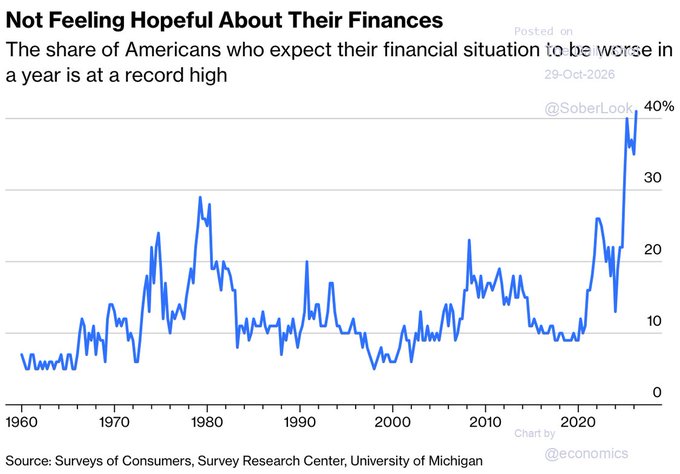
So we ask, where are the mucho wealthy strategists at US investment banks with their estimates about how a a slowdown outside USA will end up impacting the US economy? If in doubt, they should ask the majority of Americans how they feel!
- Mike Zaccardi, CFA, CMT 🍖@MikeZaccardi – A record share of Americans expects their financial situation to worsen over the coming year. Midterms on tap @economics @soberlook https://thedailyshot.com/subscribe/
2. Markets Last Week
2.1 US Indices:
- VIX down 1.32% to 19.42; Dow down 85 bps; SPX down 58 bps; RSP up 82 bps; NDX down 2%; RUT down 1.3%; MDY up 1.3%; XLU up 2%; SMH down 89 bps; SOXL down 7.8%; NVDA down 3%.
2.2 MAGs:
- AAPL down 89 bps; AMZN down 3.1%; GOOGL down 12.6%; META down 4.3%; MSFT down 50 bps; NFLX down 5.7%; SMH down 89 bps; SOXL down 7.8%; NVDA down 3%; MU up 82 bps; SNDK down 7%; IBM up 1.7%; IGV down 5.7%; CRM down 7.8%; PANW down 3.9%; NOW down 33.9%; PLTR down 6.4%;
2.3 Key Financials:
- BAC down 1.1%; C up 1.7%; GS up 2.2%; JPM up 1.7%; KRE down 62 bps; EUFN down 8 bps; SCHW down 2.8%; APO up 2.7%; BX up 46 bps; KKR up 3.3%; XHB up 2.6%; ITB up 2.4%; NAIL up 6.5%;
2.4 – Dollar & Metals
- UUP up 14 bps; DXY up 8 bps; Gold down 3.1%; GDX down 3.9%; Silver down 8.7%; Copper down 22 bps; CLF up 2.5%; FCX down 4.2%; MOS up 3.1%; Oil down 45 bps; Brent up 25 bps; OIH up 3.6%; XLE up 1%; PBR down 15.7%;
2.5 – International Stocks:
- EEM down 1.6%; EMXC down 2.2%; FXI up 2.4%; KWEB down 1.7%; BABA down 1.6%; EWZ down 23.8%; EWY up 1.1%; EWJ down 1.3%; EWG up 2.3%; INDA up 3%; INDY up 2.7%; EPI up 2.1%; SMIN up 2.4%; IBN down 3 bps; HDB up 41 bps;
2.6 Treasuries & Interest Rates
- 30-year Treasury yield down 2.2 bps on the week; 20-yr yield down 3.9 bps; 10-yr down 7.2 bps; 7-yr yield down 8.5 bps; 5-yr yield down 9 bps; 3-yr yield down 9.4 bps; 2-yr yield down 9.4 bps; 1-yr down 2.8 bps;
- TLT up 61 bps; EDV up 42 bps; ZROZ up 21 bps; TMF down 1.7%; HYG up 49 bps; JNK up 50 bps; EMB up 44 bps;
3. CNBC & Hindu Dharma – Never Stops!
Writing about 2007-2008 in Section 1 above reminded us of August 2008 when we wondered in writing if CNBC Anchors were on a Mission against US Treasuries? That article was written & posted on August 23, 2008, about 3 weeks before September 15 2008, the day Lehman filed for Chapter 11 bankruptcy protection. That, as most remember, launched a severe sell-off in stocks & a big rally in US Treasuries.
You would think that episode would have convinced CNBC of the value of U.S. Treasuries in investor portfolios. If you think so, you just don’t know CNBC. Just witness their animosity towards to U.S. Treasuries this summer.
But their contempt of Treasuries pales before CNBC’s contempt of Hindu Dharma as realized by their insistent maltreatment of Sacred Hindu Names & Terms on their network. And this public contempt was broadcast to the world on May 17, 2008, almost 4 months prior to their published contempt of U.S. Treasuries. On May 17, 2008, Mark Haines of CNBC backed by his co-anchor Erin Burnett announced to the World that he didn’t care about Sacred Cows & if he were hungry, he would eat it anyway. Then, as we wrote then, he added:
- “Look, If I am hungry, if I am hungry, you don’t want to be a sacred cow walking down the street in front of me; I don’t care if you are a sacred cow…”
We were outraged & even CNBC recognized they had gone too far. So they arranged for Mark Haines to call us. It was a frank & candid call as we recall. Not only did he apologize, he also said that he was told it would be taken as a joke and Haines had NOT written that expression. Some one else, either a fellow anchor or a producer-writer had composed it. That call actually made us respect Mark Haines as a man, a unique anchor at CNBC.
3.2 CNBC’s long-term mal-treatment of Hindu Names, Figures & Terms
You would think that horrible episode would have changed CNBC’s mindset or behavior. You forget that CNBC is made of much sterner stuff. CNBC Anchors kept being uncharitable, shall me say, about Hindu Dharma, Sacred Hindu names every now & then. We would protest and they would suspend their abuse for awhile. Then they would resume again.
Witness what happened to a female Indian-origin CEO of a national firm on CNBC just about a month ago. The CEO’s Hindu name is a common Sanskrut-origin name appropriate for an elegant, sophisticated woman. Instead, an Indian-origin CNBC anchor called the CEO via a similar sounding but Muslim-type North Indian name that means a “bi*ch” type adjective. We would never have believed this outrageous abuse had we not watched it happen live. We think CNBC was shocked at the insult and we thought things would improve.
But as we said, CNBC is made of sterner stuff. This past week, about a month after the above incident, a different CNBC anchor crossed a very big line this past week, a line that goes back to the formative period of Hindu Dharma (about 6,300 BC according to an earlier calendar and 21,000+ years ago according to a modern Astronomy calendar).
This insult to Sacred & Historical Hindu Dharma figures is of a far bigger magnitude and it demonstrates the respect CNBC Anchors are taught to demonstrate for Muslim figures and the utter contempt they show for far greater Hindu figures.
Many might remember the discussion about the pronunciation of the name of Mr. Abdul El-Sayed. He himself illustrated the pronunciation as we recall. This past week, CNBC’s Comtessa Brewer perfectly pronounced Mr. El-Sayed’s name when reporting on the story. We respect Ms. Brewer for her preparation before coming on air and we don’t recall her every misstating or mispronouncing names. Also we do not remember hearing a Muslim name mispronounced on CNBC. Perhaps it is the MSNBC heredity or perhaps it is CNBC’s healthy respect for the fear of making Muslims angry.
In stark contrast to Ms. Brewer, look what CNBC’s Mike Santoli did on Tuesday, October 27. He had invited Merrill Lynch Economist Bhave (pronounced Bhaave) to discuss what Fed Chair Warsh might do the next day. Allow us to admit that we have a natural positive affinity towards the Bhaave heritage & hence towards Mr. Bhaave. The name makes him a Chit-Paavan Braahman, a historical geneology that he shares with major thinkers, writers. It also happens to be the maternal heritage we inherited.
But then, Mike Santoli mispronounced (quite horribly, based on the meaning) Mr. Bhaave’s first name. It seemed to us that Mr. Bhaave did not mind the mis-pronunciation or did not even understand it. It is also possible that Mr. Bhaave himself told Mr. Santoli to pronounce it the way Mr. Santoli did. This last point does not absolve Mr. Santoli of his responsibility. The reason gets right back to the courtesy extended to Muslim names by CNBC.
We are absolutely confident that no anchor at CNBC would allow a celebrated Muslim name to be mispronounced on CNBC’s air even if the guilty party was Muslim. Because CNBC’s discipline seems to mandate that the pronunciation of an important religious Muslim name be correct & sacrosanct despite the habits of an individual Muslim speaker.
As we see, this was not extended to the name of Mr. Bhaave. Based on an earlier episode, we had informed CNBC the correct pronunciation of Mr. Bhaave’s name & the reasons for respecting it. So it was incumbent on Mr. Santoli to say it correctly. He did not. This worsened the nature of the offence imposed on Hindus by CNBC’s Mike Santoli.
3.3 The Sacrosanct Aditi name & the semi-celestial Aaditya, sons of Aditi
No name is more central to the Hindu Dharma & history than Aditi or grammatically A-diti. The vowel “A” at the start is used to negate the remaining. So since “diti” means bounded, the name A–diti means unbounded or limitless. It is written in Sanskrut Dev-Naagari script as अदिति. Look how even Wikipedia describes her:
- “She is the personification of the sprawling infinite and vast cosmos. She is the goddess of motherhood, consciousness, unconsciousness, the past, the future, and fertility“
- She is mentioned more than 250 times in the Rigveda, the verses replete with her praise, the Rg-Ved being the oldest & most important religious & philosophical text reputed to be the oldest book extant.
Aditi’s importance also stems from her 12 sons, all of whom became Celestial Deities. In Sanskrut, the derived class of a name beginning with “A” is signified by adding another A. So the sons of Aditi became known as Aaditya written in Sanskrut as आदित्य. Notice that “a” sound in signified as अ with a single vertical bar, while the “aa” sound for the names of her sons is signified by an extra vertical bar आ.
Hopefully it is amply clear that the आ or Aa pronunciation is strictly for the sons of Aditi while the अ or A pronunciation is strictly for the mother. This is possible because Sanskrut has 12 vowels for rigorous pronunciation while English has only 5 vowels. More specifically the “a” is used in English for both the creator-deliverer & the derived.
The first name of Mr. Bhaave of Merrill Lynch is erroneously spelt by both him & Mr. Santoli as Aditya. The spelling is unimportant. The deep insult comes from pronouncing Aaditya as Aditya, thereby removing the glory & reality of being the Sons of Aditi, the Goddess mother.
Now listen to the first couple of sentences of the CNBC clip of Santoli speaking with Bhaave and understand the insult heaped by Santoli by calling Bhaave as Aditya & the inability/ignorance of Bhaave in accepting it.
We think both CNBC & Mr. Bhaave are entering dangerous territory if they keep using the Aditya pronunciation instead of the correct Aaditya pronunciation. An even simpler solution might be CNBC Anchors being more formal & calling him Mr. Bhaave or Dr. Bhaave if he has a Ph.D. On the other hand, it might be simpler to just pronounce Aaditya.
The Political Impact of this Aaditya issue
Allow us to insert the profile of a massively popular Indian politician & the Chief Minister of the largest state in India. He is already unique as the first politician to win two successive election victories in Uttar Pradesh. He was the head Mahant (chief Priest) of the famous Gorakh-Nath Math, monastery in Uttar Pradesh. He was given the name Yogi Aditya-Nath when he became the Mahant of the Gorakh-Nath Math. He uses the Aditya spelling as is common in India. But the pronunciation is explicitly Aaditya.

He & his party are preparing for his 3rd election in 2027 and the campaigning has already begun. His state is also the most important state for Prime Minister Narendra Modi. His goal was to make Uttar Pradesh as a largest religious tourism destination in India and, we believe, he has already achieved that by building roads & highways to connect all the religious sites in his sprawling state.
So we hope both CNBC & Merrill Lynch realize that the story of Aditi & her sons Aaditya is not only central to Hindu Dharma but it is now a massive source of religious electoral power.
We went into so much detail because of Mr. Bhaave being from the same genealogical heritage as our mother & her parents. Believe it or not, we wish him well. But he needs to stop insulting the earliest history of Hindu Dharma by mixing अ andआ into one sound that insults both the Goddess Mother & her Celestial Deity sons.
Which one might be easier for Mr. Bhaave? Using the correct Sanskrut pronunciation of his first name OR accepting our view that the next move from Chair Warsh will be a cut of 25 bps or more? The first might improve his religious standing while the second might improve his financial health/career. Or, as Deion Sanders said to Jerry Jones, he should answer Both.
Send your feedback to editor.macroviewpoints@gmail.com Or @MacroViewpoints on X.
