Summary – A top-down review of interesting calls and comments made last week in Treasuries, monetary policy, economics, stocks, bonds & commodities. TAC is our acronym for Tweets, Articles, & Clips – our basic inputs for this article.
Editor’s Note: In this series of articles, we include important or interesting Tweets, Articles, Video Clips with our comments. This is an article that expresses our personal opinions about comments made on Television, Tweeter, and in Print. It is NOT intended to provide any investment advice of any type whatsoever. No one should base any investing decisions or conclusions based on anything written in or inferred from this article. Macro Viewpoints & its affiliates expressly disclaim all liability in respect to actions taken based on any or all of the information in this article. Investing is a serious matter and all investment decisions should only be taken after a detailed discussion with your investment advisor and should be subject to your objectives, suitability requirements and risk tolerance.
1. Two Important Days & Three Important Holes in the Dam
It began on Thursday with Broadcom going down hard and Treasury yields falling. But then Broadcom rallied somewhat. Dan Niles highlighted this rally by saying on CNBC (at about 2:02 pm) that “if you are a semiconductor Bull, you are ecstatic“. That actually proved to be the peak of Broadcom on Thursday & the stock gave up some of its bounce by Thursday’s close and SOX closed down 2.2%. Friday was, of course, worse. Interestingly, Treasury yields across the entire curve fell on Thursday.
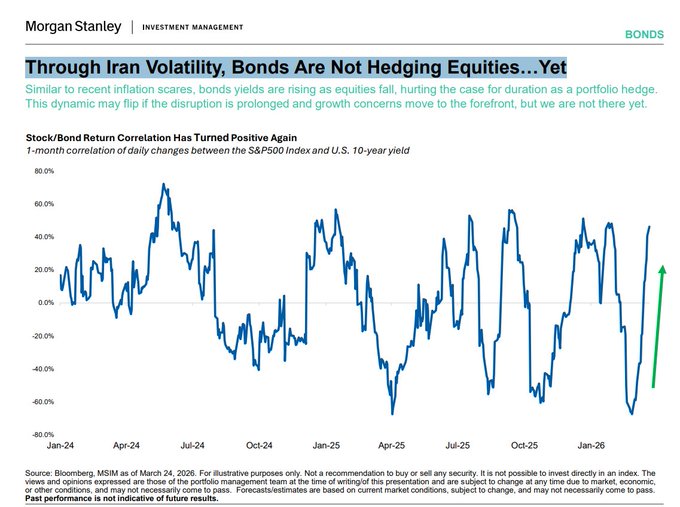
On Friday came the payrolls number. And the dam broke or at least a big hole opened in it. SOX fell 10.3% on Friday, with NDX down 4.8%. And Treasuries reversed the rally on Thursday by yields jumping across the curve with 3-yr & 2-yr yields jumping 11 bps. That fit in well with this year’s correlations:
- Mike Zaccardi, CFA, CMT 🍖@MikeZaccardi – MS: Through Iran Volatility, Bonds Are Not Hedging Equities…Yet This dynamic may flip if the disruption is prolonged and growth concerns move to the forefront, but we are not there yet.
Just rates alone is a known issue & Mag 7 stocks can adjust. But another hole appeared in the Dam on Friday. First Google announced a capital raise via its stock and then Meta announced the same later. This is a big deal because it brings into question the “no problem in funding AI for Mag 7” comfort level that was based on the belief that cashflows in those huge Mag 7 stocks would be enough to fund the AI buildout.
Remember the confidence that Mag 7 would be able to buy back stock despite spending on AI was proved wrong earlier this year. Now we see Google & Meta selling their stock to fund their AI buildout.
This might prove to a serious blow if not a decisive one. After all, no one really understands or has estimated how much money the Mag 7 would make from their AI buildout. In the words of Gautam Mukunda (“a pronunciation” NOT “aa”), “this is the effervescence, the enthusiasm surrounding AI meeting the reality of having to pay for it“. Besides the backers & the detractors, he said in the Bloomberg clip below:
- “There’s a third scenario, which it’s it just strikes me no one talks about, which is you can have a revolutionary, world changing, astonishing technology that doesn’t end up making anyone any money. Uh-huh. And this is the thing that I don’t see people talking about. And I’ll give you two examples.
- The airline – no one would deny that the airline industry, right, just change the world. Right? And you can go anywhere. Perfect safety and EP nuts on the way. Just remarkable. But, you know, Warren Buffett famously said that the airlines were such a machine for incinerating capital that if an enterprising cat if an enterprising capitalist had been at Kitty Hawk when Orville took his flight, he should have shot the thing down. Right? You can change the world and not make money.
- In biotech, you saw sort of, you know, the biotech revolution starting 1975. So from 1975 to 2004, Gary Pisano at Harvard Business School showed that the biotech industry might maybe have made money in one year. Right? And for that entire time, it was essentially just a furnace for money. You poured money in and, you know, drugs came out, life came saved, but people didn’t make money.
Then there is the national danger from Chinese competition in AI:
- “And you’ve got huge capital investments, lots of uncertainty, long delays before payoff, enormous costs. Oh, and the problem that, you know, that AI is dealing with that biotech didn’t is the open weights labs out of China in the last benchmarks are four to eight months behind.”
Now let us go back to the first example Mr. Mukunda gave in the above clip – “there’s a company I was talking to the CEO yesterday. He said, if Claude charged us 10 times what it does right now, he said, I would pay it, and I wouldn’t hesitate. He’s like I wouldn’t even think twice.” When asked what kind of a company it was, he replied “It’s a small health care company“. (The clip above also has an interesting discussion about data centers & the politics around data centers.)
He also makes a key point about the VCs who find scale in AI to be very different than they did with SaaS:
- “I think a lot of the sort of especially the VCs who went into AI find so heavy. They’re kinda used to investing in SaaS companies, right, where scaling costs zero, and the marginal cost of production is zero. But AI is profoundly quite different. Right? Because they don’t see as users go up the marginal cost going down that much. … Like, just these things are really expensive to run. And so the scaling of this involves capital expenditures and physical construction and, you know, simple stuff. Pouring concrete, wiring buildings, those things are hard. Right? They’re not like dumping code onto the Internet. …. It it’s the the the guys … and the women who do physical labor are becoming constraint here. That is unlike most things that the software … that this world has seen before. .”(The clip above also has an interesting discussion about data centers & the politics around data centers.)
That example brings us to a major financial company that created a team of people around the world and clearly sees ROI benefits . Ulrike Hoffman-Burchardi, UBS CEO for Global Equities, makes some key points based on her & her team’s experiences in her conversation with CNBC’s Andrew Ross Sorkin below:
- Ulrike – “SO FOR THE MARKETS, GEOPOLITICS HAS SHORT LEGS BUT LONG SHADOWS. SO ON AVERAGE THE EQUITY MARKETS REBOUND FOUR WEEKS FROM THE ONSET OF CONFLICT. BUT THEY DO HAVE LASTING STRUCTURAL IMPACTS ON THE ECONOMY. AND WE SAW THAT IN 1973 FOR EXAMPLE. RIGHT. MUCH MORE INVESTMENTS INTO ENERGY INDEPENDENCE. STRATEGIC OIL RESERVES ALSO REFOCUS ON FUEL EFFICIENCY AND RENEWABLES. AND I THINK WE’LL SEE THE SAME THIS TIME AROUND…. .”
Ulrike – “ENERGY INFRASTRUCTURE AND POWER. AND I THINK WE HAVE SEEN THIS IN THE MARKET. WHAT WE’VE SEEN SO FAR IS THAT ENERGY AND ALSO SEMICONDUCTORS HAVE LIFTED THE MARKET SO FAR THIS YEAR“.
Ulrike – ” I WOULD SAY THAT AI IS EVEN THE DIVIDING LINE FOR GEOPOLITICS. AND SO NOT JUST FOR THE MARKETS, BUT ALSO IF YOU WANT TO BE ON THE RIGHT SIDE OF THE ECONOMY AND GEOPOLITICS, YOU BETTER BE ALSO THE LEADER IN AI. SO I THINK IT TRANSCENDS A LOT OF DIFFERENT DIMENSIONS. - Ulricke – ” SO I THINK RIGHT NOW FOR ME, ACTUALLY, A MORE INTERESTING QUESTION THAN MAYBE THE FLOW QUESTION THAT YOU’RE ALLUDING TO IS REALLY HOW DISRUPTIVE AI IS TO INCUMBENTS. OKAY. WHEN WE LOOK BACK AT AT PARADIGM SHIFTS IN THE PAST, WE HAVE SEEN LEADERSHIP IN THE MARKET CHANGING.
- IF YOU THINK ABOUT THE MAINFRAME ERA, FOR EXAMPLE, IBM WAS THE DEFINING COMPANY OF THE MAINFRAME ERA. THEN IT PASSED THE BATON TO INTEL, MICROSOFT, AND THEN, OF COURSE, APPLE TOOK THE LEAD WITH MOBILE COMPUTING, THE FIRST $1 TRILLION COMPANY. RIGHT. I THINK THE QUESTION NOW IS HOW DISRUPTIVE AI IS TO THOSE MARKET LEADERS.”
- Ulrike – “YEAH. SO WE HAVE SEEN WHAT HAPPENED IN SOFTWARE, BUT I THINK AI CODING IS SO DISRUPTIVE TO SOFTWARE. AND I THINK AGENTIC AI COULD VERY
SIMILARLY BE AS DISRUPTIVE TO THE INTERNET, BECAUSE IF MORE AND MORE AGENTS ARE EXECUTING ON OUR BEHALF, THE POWER BALANCE CAN SHIFT AWAY FROM INTERNET TO THOSE AGENTIC PLATFORMS.”
Then Sorkin asked – “HAVE YOU CHANGED INTERNALLY AT THE FIRM ITSELF, HOW YOU’RE OPERATING, HOW MANY PEOPLE YOU’RE HIRING, WHO’S ON YOUR TEAM, EVERYTHING ELSE AS A RESULT OF AI?”
Ms. Hoffman-Burchardi replied with a “Real Money” answer, which if it works, will fundamentally change both the market returns & the profitability of achieving market returns.
- “WE HAVE ACTUALLY ONE OF THE THINGS THAT I THINK THAT IS SO UNDERAPPRECIATED BY THE MARKET IS HOW LITTLE THE TRADITIONAL FACTOR BUCKETS OF COUNTRY, SECTOR STYLE AND SIZE CAPTURE IN TERMS OF INVESTMENT RETURNS IN THE EQUITY MARKETS. SO WE ACTUALLY FORMED A TEAM THAT IS FOCUSED ON AI TWO YEARS AGO. IT’S A GLOBAL TEAM. IT’S NOT A SECTOR TEAM TO UNDERSTAND THE INVESTMENT OPPORTUNITY AND THEN TO COME UP WITH PORTFOLIOS AND PUBLISH ON THOSE PORTFOLIOS TO CAPTURE THE INVESTMENT OPPORTUNITIES THAT WE ARE SEEING FOR THE NEXT DECADE. AI, ELECTRIFICATION, POWER AND RESOURCES IS HOW WE CALL IT, AND LONGEVITY. AND THAT’S A VERY DIFFERENT STRUCTURE TO WHAT MOST INVESTMENT FIRMS EMBRACE.”
Then Sorkin asked about whether the physical number of people on her team is more or less than 3 yrs ago? Her reply was the number was the same but they are leveraging AI to be even more productive.
Then Sorkin asked the money question:
- “OKAY. AND DO YOU BELIEVE THAT THERE’S A GENUINE ROI ON THAT? THAT’S THAT’S THE FUNDAMENTAL QUESTION RIGHT NOW THAT I THINK SO MANY CEOS ARE LOOKING AT BECAUSE THEY’RE LOOKING AT A MASSIVE SPEND, HUGE CAPEX SPEND, AND THEY’RE NOT NECESSARILY ARGUING THAT THEY’RE SEEING THE REVENUE COMING IN ON THE OTHER SIDE YET.”
Ms. Hoffman-Burchardi was explicit & emphatic in her response:
- “I THINK THE ROI IS CLEAR. WE SEE IT IN CODING. WE’VE ALSO SEEN IN MATH. I MEAN, TWO WEEKS AGO, WE SOLVED AN UNSOLVED MATH PROBLEM THAT WAS UNSOLVED BY HUMANS FOR 80 YEARS. SO THE QUESTION IS, HOW DO YOU OPERATIONALIZE IT? AND I THINK THERE’S PROBABLY MORE TO GO. BUT THE ROI IN ANY TYPE OF KNOWLEDGE WORK IS VERY CLEAR.”
Now allow us to focus on something that is of paramount importance to us. Sorkin admitted that he could not say the 2nd half of her last name & she pronounces it. Sorkin again says humbly “I can’t do it; I can’t do it“. A simple thing but it raised our respect big-time for Signor Sorkin. Why can’t other CNBC anchors follow Sorkin’s example? Or is it simply a case of being respectful to a European “white” name while remaining disrespectful to Sauns-Krut names, a la Brian Sulliva & Kelly “bananas” Evans of CNBC PowerLunch?
- Note: In a recent CNBC PowerLunch episode, CNBC’s Brian Sullivan for some weird reason dropped the middle “N” while pronouncing SriNiwas, the name of his guest, CEO of Perplexity. So we pointed out how the meaning of Brian’s own last name would change if pronounced without the “n” syllable – Brian “Sulliva“. And, in case Ms. Evans didn’t know, kids in Mumbai are taught to say “Bananas” by its Marathi name “Keli“, or “Kelli“. She has a close relative from Mumbai so she might even know this. That doesn’t make either Brian or Kelly bad people but it does highlight the basic contempt of Indian names that seems embedded in CNBC’s culture.
On a positive note on the pronunciation topic, we are delighted to see & hear CNBC used AI to correctly pronounce Aravind SriNiwas in a CNBC article about the Perplexity CEO. Now perhaps you realize why we were so thrilled with of Andrew Ross Sorkin when he spoke humbly to Ms. Hoffman-Burchardi about his inability to say her name.
Finally all the highfalutin discussion above from smart minds, how about a simple & funny message?
- Markets & Mayhem@Mayhem4Markets – oh man 💀

2.Markets Last Week
The Above-All factor:
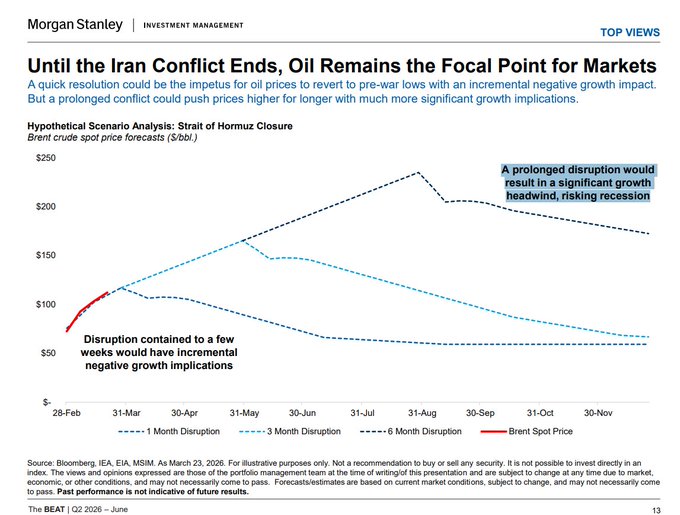
- Mike Zaccardi, CFA, CMT 🍖@MikeZaccardi – MS sees $230 Brent in a prolonged Strait of Hormuz disruption scenario, which would result in a significant growth headwind, risking recession The Beat June 2026
2.1 US Indices:
- VIX up 40.4%; Dow down 32 bps; SPX down 2.6%; RSP down 48 bps; NDX down 4.5%; RUT down 2.9%; MDY down 88 bps; XLU down 16 bps; SMH down 4.9%; SOXL down 18.6%
John Kolovos of Macro Risk Advisors had appeared on CNBC on Thursday & had warned about S&P 500 breaking below 7500. He got to come back on Friday after the close and said:
- “I do think odds for a summer swoon have increased after today; as I said yesterday if we break 7,500 on S&P , that would be the first clue & if we see a follow through underneath the 7,300 area, that would confirm that a top of sorts is in; … today was an important day in that corrective process & looking forward if you break 7,300, you could test the 50-day around 7170 but ultimately I do think that the summer months will require a retest of Q1 highs closer to around 7,000; ……. breadth statistic today were not awful but the leadership groups were destroyed … 95% of the tech sector was down; similar with energy … breadth of momentum leaders was awful …. “
- “what I think is in important is interest rates rebounded on the 10-yr yield … & continued to push up higher …. that’s a big part of what we see going forward …
- “this is still a secular bull-market but unfortunately the perch on which these stocks were on are so high that there is a lot of air to come out ...”
What about sectors?
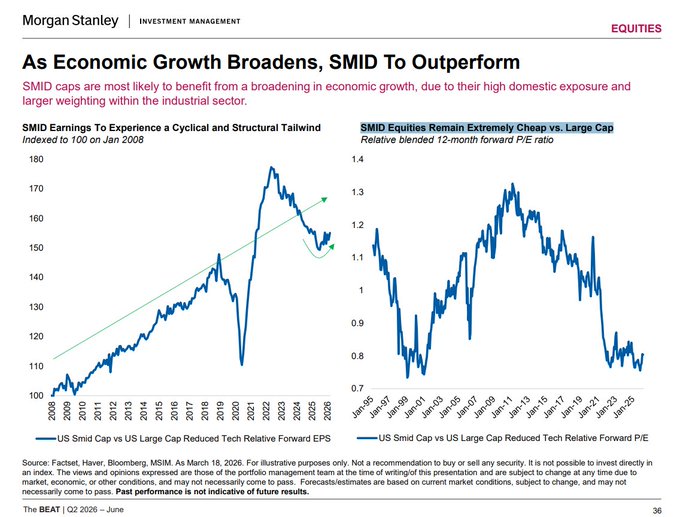
- Mike Zaccardi, CFA, CMT 🍖@MikeZaccardi – GS: As Economic Growth Broadens, SMID To Outperform: –SMID Earnings To Experience a Cyclical and Structural Tailwind–SMID Equities Remain Extremely Cheap vs. Large Cap
On the other hand, Ed Yardeni , focused on Big Caps, reconfirmed his year-end target of 8,250 on the Dow.
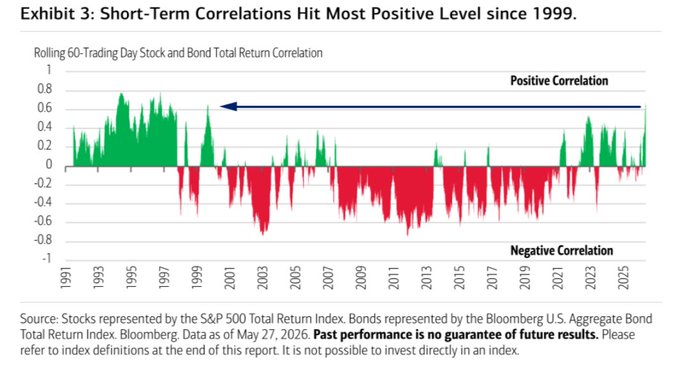
Yardeni says this not 1999 at all. If he is right, the chart below should change either via stocks going up or Interest Rates going down:
- Mike Zaccardi, CFA, CMT 🍖@MikeZaccardi – Jun 6 – Bonds are now the most correlated with stocks on a short-term basis since 1999 BofA Merrill
2.2 MAG 7:
- AAPL down 1.5%; AMZN down 9.1%; GOOGL down 3.1%; META down 6.3%; MSFT down 7.5%; NFLX down 4.5%; NVDA down 2.9%; MU down 11%;
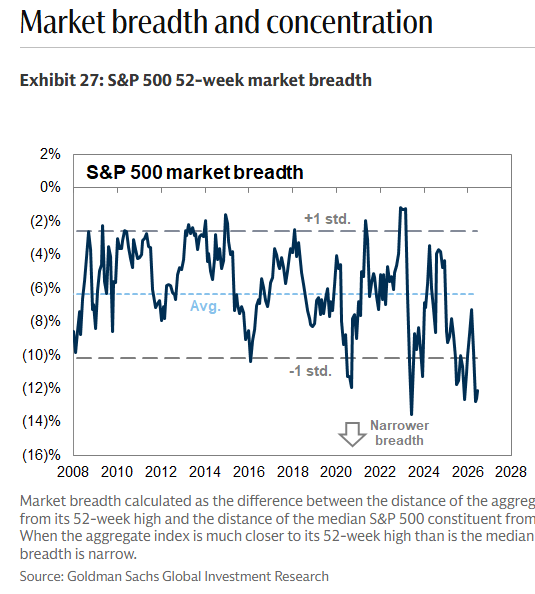
An indication of “how much air has to come out of” the leading stocks is below, to use a John Kolovos expression!
- Mike Zaccardi, CFA, CMT 🍖@MikeZaccardi – Weak market breadth, as measured by how high the leading stocks are and how far from 52wk highs the median stock is
2.3 Key Financials:
- BAC up 4.3%; C up 5.2%; GS up 1.3%; JPM up 4.4%; KRE up 80 bps; EUFN down 3%; SCHW up 1.7%; APO down 53 bps; BX down 1.4%; KKR down 2.7%; XHB up 86 bps; ITB down 17 bps; NAIL down 65 bps; IGV down 5.7%; CRM down 2.9%; PANW down 3.4%; NOW down 9.6%
Private credit banks are down while the Big Banks are up. But the difference is small despite all the news about private credit, private equity out this week. So is the below right?
- Mike Zaccardi, CFA, CMT 🍖@MikeZaccardi – MS: Private Credit Headlines Point to a Reset, Not a Leverage Shock
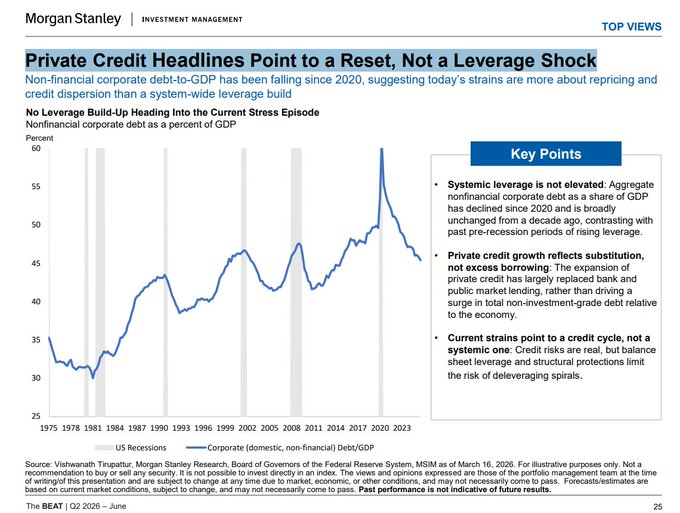
And Rick Rieder reiterated his view on Friday morning on BTV that Private Credit is not a systemic risk.
2.4 – Dollar & Metals
Dollar was up 1.3% on UUP & up 1.2% on DXY:
- Gold down 5.1%; GDX down 12%; Silver down 10%; Copper down 2%; CLF down 51 bps; FCX down 3.6%; MOS down 7%; Oil up 2.6%; Brent up 1.2%; OIH down 85 bps; XLE down 2.5%;
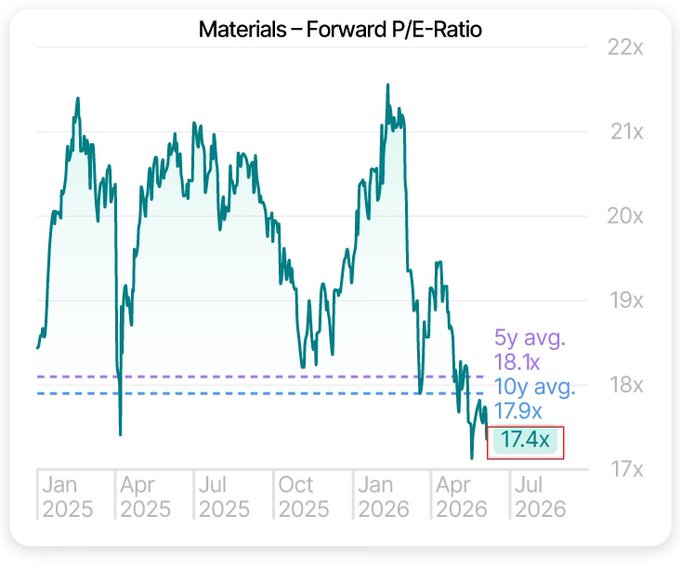
Again cheap sectors got hit the worst:
- Mike Zaccardi, CFA, CMT 🍖@MikeZaccardi – Materials is now quite cheap vs recent history 17.4x $XLB @dualityresearch https://dualityresearch.substack.com
2.5 – International Stocks:
- EEM down 5.9%; FXI down 86 bps; KWEB down 1.3%; EWZ down 5.3%; EWY down 14.9%; EWG down 3%; INDA down 2.5%; INDY down 3.1%; EPI down 2.4%; SMIN down 1.5%;
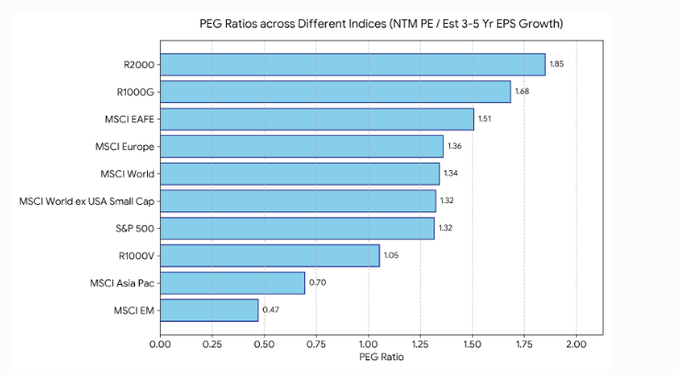
Why do low-PEG sectors usually fall faster & lower?
- Mike Zaccardi, CFA, CMT 🍖@MikeZaccardi – EM PEG ratio just 0.5x.. based on 12.2x fwd P/E and 3-5yr EPS growth of 26%, per MS @factset data SPX 1.32x, close to Europe, MSCI World, Ex-US Small Cap US Russell 1000 Value cheap PEG of 1.05x
2.6 Treasuries & Interest Rates:
- 30-year Treasury yield down 8.4 bps on the week; 20-yr yield down 9.9 bps; 10-yr down 11.7 bps; 7-yr down 11.4 bps; 5-yr down 11 bps; 3-yr down 11.8 bps; 2-yr down 11.7 bps; 1-yr down 7 bps;
- TLT down 82 bps; EDV down 14 bps; ZROZ up 13 bps; HYG down 1.1%; JNK down 1.1%;
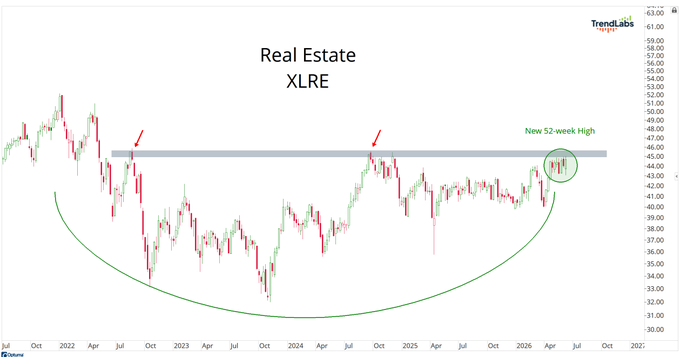
Can Real Estate rally if interest rates shoot up & Fed raises the Fed Funds rate? Or is the below a sign that interest rates are not going to shoot up?
- J.C. Parets@JC_ParetsX – Real Estate quietly closing at a new 52-week high
Those who follow David Rosenberg might recall that, after months of being too early or in error, June tends to show a turn in his views proving truer. Is that likely this year?
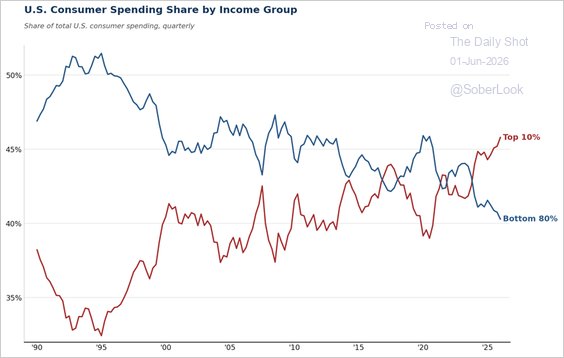
And notice the share of consumer spending shown among the bottom 80%. Is the below why the economy seems stronger?
- (((The Daily Shot)))@SoberLook – Most Favorited Chart of the Week — The spending share of the top 10% by income is pulling further ahead. Source: @SteveRattner
3. Wow; Knicks or old Celtics:
Yes; we had heard of this New York Knicks team. Yes; we watched Game 1 of the finals. But winning the 1st game is not uncommon and Game 2 would be different. It was until the last 2:30 minutes and then you know, the Knicks turned into the old Celtics – tenacious defense, rebounds & flawless play. Spurs had the last play & could have won. But these are Knicks & they have Jalen Brunson.
4. Never ever seen before!
India has produced a lot of top batsmen in World Cricket including Sachin Tendulkar, the greatest player of all time, and before him Sunil Gavaskar of whom they still sing in West Indies. But all these players were winners in the classic style – steady game with iron fortitude. They won but did not stun as great individual batting of Chris Gayle, Viv Richards, Clive Lloyd & so many others did – the destructive, forceful batting that destroys the minds & hearts of other side & then bowlers.
Until now, that is. This year saw the stunning emergence of 14-year old Vaibhav Soorya-Vanshi who burst on World Cricket in the 2026 World Cup. This month he began his pro career in IPL with unbelievable power & skill.
And today’s greats & past greats unanimously say they have never seen a young man of such power, such accuracy & such talent. And he is still 15 yrs old. Look what he did last week:
If you want pure play instead of words, watch him destroy England in the finals of U19 World Cup earlier this year when he was merely 14 yrs old. Seriously, watch the 5:45 minute clip below. You don’t need knowledge of Cricket to be stunned by what you see just like you don’t need knowledge of baseball to watch a game in which a 14-yr old hits 15 home runs in a championship final.
This also shows how widespread is the growth of Cricket & the spread of talent-seekers & coaches in India. And how happy must be the Happ Family (owners of Detroit Lines), Ron Walton, the son of Sam Walton, & the Arizona billionaire Samani be? These three stepped up and purchased the Rajasthan Royals team as we reported on May 3, 2026. Their team got this unbelievable talent in this year’s IPL draft.
And what a name this young man has? Vaibhav means wealth & his last name is Soorya(sun)-Vanshi(dynasty). Now, this 15-year old young man has become the wealth of not just his Sun-Dynasty family but of India and the entire cricketing world.
Seriously, watch the 5:45 clip above and marvel at the hits that effortlessly soar out of the stadium. If you like what you see, ask Mark Lazarus to contact the Detroit Lions & get their spokesman for IPL to talk a bit about this out-of-the world talent on air. That will set CNBC apart from all the other stupid coverage of India.
Send your feedback to editor.macroviewpoints@gmail.com Or @MacroViewpoints on X.
