Summary – A top-down review of interesting calls and comments made last week in Treasuries, monetary policy, economics, stocks, bonds & commodities. TAC is our acronym for Tweets, Articles, & Clips – our basic inputs for this article.
Editor’s Note: In this series of articles, we include important or interesting Tweets, Articles, Video Clips with our comments. This is an article that expresses our personal opinions about comments made on Television, Tweeter, and in Print. It is NOT intended to provide any investment advice of any type whatsoever. No one should base any investing decisions or conclusions based on anything written in or inferred from this article. Macro Viewpoints & its affiliates expressly disclaim all liability in respect to actions taken based on any or all of the information in this article. Investing is a serious matter and all investment decisions should only be taken after a detailed discussion with your investment advisor and should be subject to your objectives, suitability requirements and risk tolerance.
1. Markets this past week:
1.1 US Indices:
- VIX up 8.7% at 15.74; Dow down 29 bps; SPX down 37 bps; RSP up 73 bps; NDX down 92 bps; SMH up 2.9%; RUT up 2.1%; MDY up 1.3%; XLU up 2.1%;
A signal:
- Seth Golden@SethCL – Jan 17 – Most bullish quant signal was triggered Friday, with $SPX gaining 4% in TOY Barometer period! I will be allocating ***** additional capital to my portfolio to lean into this such Bullish signal. More in this Sunday’s macro-market Research Report (*members only) $ES_F $SPY $QQQ $NYA $IWM $DIA $SOXX $AAPL $NVDA $RUT $VOO $META $MSFT $MAGS

The above was followed up by:
- Seth Golden@SethCL- Jan 17 – With a Bullish TOY signal now triggered: – 96% positivity rate 12-months forward;35 up, 2 down; $SPX Average return = +16.5%; $ES_F $SPY $QQQ $IWM $NYA $NVDA $AAPL $NDX $VOO $DIA $GLD $BTC $ETH $SLV $MAGS $SOXX
- Bullish Midterm Years triggered:
1954 = +36%
1958 = +35%
1986 = +29%
2010 = +11%
2018 = (-5% Fed rate hikes/QT)
- Bullish Midterm Years triggered:
And,
- Seth Golden@SethCL – Sun 1-18 – All 3 cap-tier level Summation Indices are sharply up-trending. All technical signs point to buying any and every dip near-term. $SPX $NDX $QQQ $NYA $IWM $IJR $RUT $SPY $DIA

On the other hand:
- Markets & Mayhem@Mayhem4Markets – 1-17 – We’re getting very stretched here. Would look for consolidation or a pullback before adding to longs.

1.2.Key Stocks:
- AAPL down 1.5%; AMZN down 3.3%; GOOGL up 44 bps; META down 5%; MSFT down 4.1%; NFLX down 1.6%; NVDA up 81 bps; MU up 5.1%; BAC down 5.2%; C down 2.7%; GS up 2.5%; JPM down 5.1%; KRE up 55 bps; EUFN up 1.2%; SCHW up 3.6%; APO down 1.3%; BX up 3.7%; KKR down 2.4%.
Speaking of our favorite play in tech,
- Larry Tentarelli, Blue Chip Daily@bluechipdaily – Jan 17 – Semis $SMH and software $IGV trending in opposite directions. Stay with the leaders until they stop leading.

Allow us to take you back to our June 8, 2025 article in which we highlighted a call by Jason Leavitt with the chart he posted then:
- “kudos to the below for highlighting SOXL in the classic “sales-trader” manner. And SOXL did close the week at $19.18 about 6.5% above the $18 breakout signal.”
- Jason Leavitt, LeavittBrothers.com@JasonLeavitt – June 3 – $SOXL – looks good to me
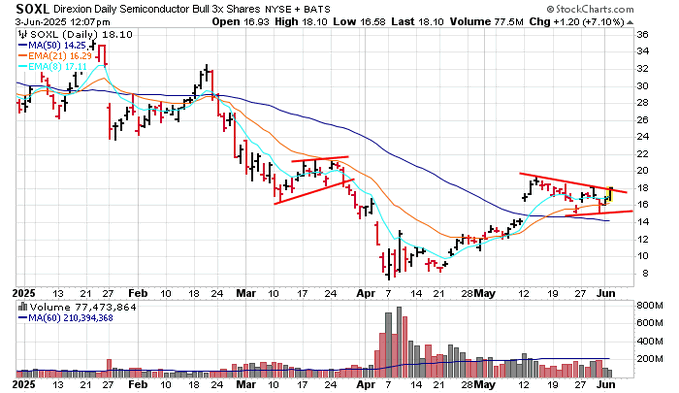
Guess where SOXL closed this Friday – $60.75 – more than 3 times the $19.18 price of June 3, 2024, the date Mr. Leavitt wrote “looks good to me“. What a great call!!!
Now SOXL is triple-leveraged SMH while the ticker below is just an unlevered stock ticker. But will $ADBE at least look better 6 months from now?
- Markets & Mayhem@Mayhem4Markets – Jan 17 – Is $ADBE becoming attractive here? 🤔

1.3 Dollar & Metals
Dollar was up 31 bps on UUP & up 22 bps on DXY:
- Mike Zaccardi, CFA, CMT 🍖@MikeZaccardi – S&P 500 EPS could really soar this year if the dollar were to break down ($DXY is flat/slightly higher since the middle of last year) @wisdomtreefunds Weaker Dollar = Higher S&P 500 Earnings

- Gold up 1.7%; GDX up 5.1%; Silver up 11.8%; Copper down 83 bps; CLF up 9.7%; FCX up 3.9%; MOS up 1.4%; Oil up 1.1%; Brent up 1.8%; OIH up 2.9%; XLE up 2.2%;
1.4 International Stocks:
- EEM up 1.3%; FXI down 13 bps; KWEB down 33 bps; EWZ up 33 bps; EWY up 3.1%; EWG down 21 bps; INDA down 61 bps; INDY down 77 bps; EPI down 31 bps; SMIN down 1.1%;
But,
- Markets & Mayhem@Mayhem4Markets – Jan 16 – International stocks could be set for some significant outperformance if the GenAI narrative starts to unravel 👀

1.5 Treasuries & Interest Rates:
- 30-year Treasury yield up 1.5 bps on the week; 20-yr yield up 2.5 bps; 10-yr up 6 bps; 7-yr up 7 bps; 5-yr up 7.2 bps; 3-yr up 7.6 bps; 2-yr up 6.2 bps; 1-yr up 3.8 bps;
- TLT down 15 bps; EDV down 5 bps; ZROZ down 14 bps;
Indicators:
- Mike Zaccardi, CFA, CMT 🍖@MikeZaccardi – Jan 16 – Wage growth humming along above inflation for all income groups

How is credit reacting to this?
- J.C. Parets@JC_ParetsX – 1-18 – Credit Spreads are the tightest they’ve been since July. If the world is coming to an end, like they keep telling you, and there’s real stress in the market, you’re going to see it in credit. To be clear, we’re not seeing any of that at all. Just the opposite.

But what about the crazy up move in Treasury rates after President Trump said Kevin Hassett might be too valuable to him in his current role?
- David Rosenberg@EconguyRosie – 1-16 – So let’s get this straight. Does the Treasury market not like the odds tilting towards Warsh over Hassett because the former would be a better inflation crusher? As if that makes any sense. Or do bond investors dislike the fact that President Trump thinks he’s good looking? Totally bizarre reaction in the rates market.
2. Cheap for a reason? But destined to remain cheap or get richer?
We wrote the following about Stefanie Link two weeks ago.
- “Stephanie Link of Hightower put INDA as her Fresh Money Buy idea on CNBC Half Time this week. She has been right with similar buys like GEV. And India has underperformed in 2025 with the currency becoming weaker. We keep hearing that the fall in the Rupee has, at least to an extent, helped with tariffs imposed on India. The news flow inside America is mostly about curbs on H1-B visas & number of Indian programmers from India. On the other hand, we keep being surprised with the positive flow into the real economy in India.”
This week, she came back on CNBC to say she had sold her INDA position. And that she had bought EWZ, the ETF for Brazil. She is right to do so because Indian ETFs have been kinda dead money for awhile & no performance-based manager can hold on to a non-performing asset in a vibrantly bullish EM market.
Before getting into what some others think, this underperformance might well be akin to outperformance last year of European ETFs while economy of Europe was & remains moribund. The point was made that these country ETFs do not portray fundamentals of the country’s broad economy but that of the companies within the ETF. And the companies inside European ETFs, especially German, are global companies with a cyclical bent & they did very well last year. Hence the ETFs did well.
Now look at the top holdings of $INDA, the BlackRock ETF – Reliance, TCS, Infosys, HDFC Bank, ICICI Bank, Bharti Airtel, Hindustan Lever etc. All these are heavily owned & represent the consumer sector in India. As you might see below, the growth & the excitement in the Indian economy is centered around the defense sector & its stunning growth. None of that is being captured in the big India ETFs.
Go back a few years to see that US Corporate investments & transactions in India involved Indian companies on the other side driving the growth of TCS/INFY/ICICI/HDFC etc. That is not true any more. JPM Chase announced last year that India had become its second largest base in terms of employment, meaning JPM is now driving its growth in India internally & not by sharing its growth with Indian companies. If we remember correctly, Goldman did say last year that their 2nd largest office in the world was now Mumbai.
Understand that means the growth seen by JPM, GS & so many others will NOT be seen or included in the numbers put out by Indian companies. That growth will be included internally in US company numbers. So $INDA & other ETFs don’t incorporate that growth & that does, to an extent, reduce the desirability of Indian ETFs as vehicles of growth in India.
Look what we read about 10 weeks ago:
- “The Stanford Global Demographics report from 2024 laid out the numbers and they’re brutal. By 2030, just 5 years from now, India will have 850 million working age citizens. That’s people between 15 and 64 in their prime productive years. The United States will have 173 million, and a huge chunk of those will be nearing retirement. ” …
- ” A 2024 study from NIT’s work innovation lab found that US companies using hybrid teams with Indian partners saw productivity increases of 34% on average. Not despite the collaboration because of it. The smart companies aren’t choosing sides. They’re building bridges. They’re recognizing that India’s youth wave isn’t a threat. It’s a resource and the companies treating it that way are the ones dominating their industries.”
The trouble is this increase in productivity is not flowing thru Indian ETFs like $INDA, etc and hence they are being left behind in the performance race.
2.1 Two opinions from long term investors:
But getting back to the traditional investing in India, but with some flexibility, we suggest you listen to Mark Mobius & Stephen Dover of Franklin Templeton below. And where are you likely to find such expertise at what might be an appropriate time? With Bloomberg’s Haslinda Amin, naturally!
First hear from Stephen Dover:
- [0:11] I was just in India last month and by long term and structurally I’m just a real India bull. … I mean, when I look back 20, 20, 25 years, there’s maybe, I don’t know, four different times where people aren’t very positive on India. And if you got in to India and any of those times, you did really well the next few years. And this may be that …. I am overweight India personally“
Then Haslinda turned to Mark Mobius and asked what is driving your optimism, Mark?
- …. first of all, the size the size of the country is incredible, Number two, the use of the population.
- Number two. Number three, the fact that you have a incredible absorption capacity of technology from all over the world because you have an English speaking elite group of people, very well educated that can absorb this technology. As you know, if you go around the world, you see Indians training in every direction and doing a lot of tech work. So all of these these components are coming together and having an incredible impact on what’s happening in India. And you must remember, the point with India is that it’s open in the sense that you have a very open economy. You have states with different states competing with each other. And this is very, very good and very, very prosperous.
- Yes, we’re at 20% now, and depending on what we can find, we’d probably go up to 30….
- Haslinda asks – You talk about how investing in Adani is investing in India. Is that still the case and how are you looking at this company and the prospects going forward?
- Mobius – Well, when you invest in Adani, you’re not only investing in India, but you’re investing in the infrastructure globally because you know, they’re very much of a global firm and they’re doing things all over the world. But I do want to emphasize Adani too much because you’ve got Reliance, you’ve got a lot of other great companies in India. We will be putting all eggs in the Adani basket.
3. What about simple folks? How do they see what is happening in India & the Big World?
Via what we once called the greatest invention of modern time!! YouTube!!! Why don’t we begin with the 8:07 minute clip titled Why Russia, Israel & Europe Shifting Arms Factories to INDIA?
3.1 – How transformational was the Ukraine war?
- “Remember how easy Russia’s entry into Ukraine was supposed to be? Russia fought Ukraine and thought it would win quickly with its advanced weapons. But the war went on for a long time and both sides kept fighting. Russia used up millions of artillery shells, but soon ran out. Russia’s factories couldn’t make more because other countries stopped selling them important parts. Russia had to use old weapons from the Soviet era, some over 40 years old, and buy shells from North Korea and Iran. Even in 2024 to 2025, Russia couldn’t make enough shells. They lost thousands of tanks and vehicles and couldn’t replace them. More than 40 Russian main battle tanks and over 100 armored fighting vehicles have been lost in recent months. They also ran out of precision missiles and had to use older, less accurate ones. This happened because after the Cold War, most countries, including Russia and Europe, stopped making lots of weapons. They only made small batches for peace time. But modern wars use up ammunition very quickly, like in World War II. Having advanced tech doesn’t matter if you don’t have enough supplies.”
- [3:31 Israel also had problems in the Gaza conflict. They used advanced systems like Iron Dome and precision bombs, but face shortages. They used up lots of shells and missiles and ran low on interceptors for Iron Dome. Israel’s factories are small and can’t make enough for a long war. They had to ask the US for help and got thousands of bombs and missiles. But even with that, Israel struggled to keep fighting. In today’s wars, drones and rockets use up lots of supplies. Israel had to use dumb bombs because they ran out of precision ones. European countries saw the same thing. They didn’t have enough ammunition and couldn’t make more quickly. The big lesson is that wars are now like marathons. You need lots of supplies, not just smart weapons. If you run out of supplies, you can lose even if you have better tech….
3.2 India with France, Germany & EU
Now let us move east towards France, a familiar host for Indian Air Force and a $35.7 billion mega deal.
First comes the almost-completed deal for 114 Rafaels to be supplied by France to the Indian Air Force with about 80% of the manufacture to be complete in India. Given the track record of Rafales inside the Indian Air Force, you would have thought this would be simple. But guess nothing is in these complex arms deals:
It is now clear that France has delivered the complete software structure for India to fit in Indian aircraft like Tejas, SU-30, & others in a seamless fashion to ensure complete battlespace integration for the Indian Air Force. It is assured that France will NOT have any access to such battlespace integration functions at all. So combat sovereignty will be complete in hands of Indian Air Force.
- That brings up the new “deal” between Germany & India in a 10:10 minute clip . It means that both sides have agreed to intensify their military ties to intensify the joint development and production of military hardware and there’s one very concrete example pending that is relating to submarines. Germany stands at the ready to build six submarines for India’s navy and to do so in India which of course comes with a component of technology transfer. This deal is very close to the finishing line although not signed yet and it stands at a worth of 8 billion euro.
- “one declaration signed on skilled labor migration from India to Germany and two more declarations that I found very important is one on working together on cooperation in the field of emerging critical technologies, read artificial intelligence and also critical minerals as both sides seek to diversify their supply chains in these fields and they look at each other to do so”
Now that brings us to the real block in Europe – a Deal between EU & India. If EU & India finally sign the long-discussed FTA, that would be huge. But, as they say, there are many a drop between the cup & the lips.
Send your feedback to editor.macroviewpoints@gmail.com Or @MacroViewpoints on X.
