Summary – A top-down review of interesting calls and comments made last week in Treasuries, monetary policy, economics, stocks, bonds & commodities. TAC is our acronym for Tweets, Articles, & Clips – our basic inputs for this article.
Editor’s Note: In this series of articles, we include important or interesting Tweets, Articles, Video Clips with our comments. This is an article that expresses our personal opinions about comments made on Television, Tweeter, and in Print. It is NOT intended to provide any investment advice of any type whatsoever. No one should base any investing decisions or conclusions based on anything written in or inferred from this article. Macro Viewpoints & its affiliates expressly disclaim all liability in respect to actions taken based on any or all of the information in this article. Investing is a serious matter and all investment decisions should only be taken after a detailed discussion with your investment advisor and should be subject to your objectives, suitability requirements and risk tolerance.
1. MV-ONR cut to 3% – Driven by Economic & Market Conditions:
This past Wednesday’s reaction to the jobs number was first elation & then virtually a surrender. The Treasury market just went downhill with 1-yr, 2-yr & 3-yr closing the week below the FF rate of 3.5%. The veteran Jim Paulsen said it succinctly on Friday:
- “I think the economy overall is weaker than widely anticipated here. I personally think inflation is not an issue. The obsession with 2% seems kind of ridiculous to me. If you look at the Job market, barely growing; you look at the housing industry being a mess. Real Retail sales have been flat for years now. Inflation has just collapsed recently. … If you just take personal consumption and investment spending; together they are growing just barely over 2%; that used to be the stall speed for the economy. The unemployment rate has already been rising for 2 years; So I think there is a lot of room for easing; I just don’t know why we stand pat”
Well, we at Macro Viewpoints are NOT standing pat. We are reducing MacroViewpoints Over-Night Rate to 3%, a reduction of 25 bps. We think it is highly consistent with the shape of the economy today and the decisive action in the Treasury market this past week.
Just to remind readers:
- In April 2025, Macro Viewpoints established our first MV-ONR rate at 3.75%. It represented a cut of 50 bps over the Powell Fed rate of 4.25%.
- On August 17, 2025, Macro Viewpoints further cut its MV-ONR rate to 3.25%, a cut of 50 bps over the previous MV-ONR of 3.75%.
- Today, Macro Viewpoints has further cut its MV-ONR to 3%, a cut of 25 bps from the August 25 MV-ONR of 3.25%.
Allow us to be direct. The descriptions laid out by Jim Paulsen do NOT include the biggest dangers afflicting the US Economy right now. These 2 dangers are not risks for the future. They are damaging the US Economy & financial wellbeing of Americans right now & neither the Fed nor the Congress are even aware of those.
Everyone has heard of the 3 monkeys illustrating the dictum – Hear No Evil; Speak No Evil; Seek No Evil.

Now recite the NEW & IMPROVED version – EXTEND & PRETEND
In section 3, we discuss the views of Bruce Richards of Marathon Asset Management about the impending crisis in Software, the sector that is being ripped apart by the stock market. There you see the Extend & Pretend focus at work in the Upper K of the US economy.
And in section 4, we discuss the views of Lakshmi Ganapathy, head of Unicus Research & her conversation with Steve Eisman about the Extend & Pretend focus on the recession already obvious in the Lower K of the US economy.
Frankly, the above two discussions reminded us of the line “nobody knows what’s in them” from the Jenga scene in the Big Short.
The key to us is that both suggest an impending monetary easing by both the monetary authorities & more importantly, the Treasury Market. Given that, we thought we would lead the way by today’s Macro Viewpoints ONR cut of 25 bps to 3%.
- PS: you couldn’t make real money in 2008 if you couldn’t get an ISDA. Same true today, we expect. But 25-30 yr Treasury Zeros worked very very well in the 2nd half of 2008.
So deja vu all over again???
2. Markets Last Week:
2.1 US Indices:
- VIX up 16% at 20.60; Dow down 1.2%; SPX down 1.4%; RSP up 30 bps; NDX down 1.4%; SMH up 1.5 %; RUT down 86 bps MDY down 71 bps; XLU up 7.3 %;
A big move up in $VIX:
- Mike Zaccardi, CFA, CMT 🍖- @MikeZaccardi – $VIX up 5 weeks running… highest Friday settle since November.

What message might RSI be sending?
- Seth Golden@SethCL – 2-14 – S&P 100 index bounce perfectly at 150-DMA and establishing a bullish RSI divergence. Lower prices are coming at higher RSI levels. Signs that index is nearing end of large-cap decline? $SPX $ES_F $SPY $QQQ $MAGS $AAPL $META $GOOGL $TSLA $NVDA $MSFT $AMZN $CRM $PLTR

What about Utilities?
- Mike Zaccardi, CFA, CMT 🍖@MikeZaccardi – 2-13 – $XLU vs $SPY … best week since November 2008. A smidgen from the top relative week back to 2001. There’s a fire in the boiler, as we’d say. @stockcharts

And the Put-Call ratio:
- Subu Trade@SubuTrade – Total Put/Call Ratio jumped to the highest reading since the Liberation Day crash.

And, a perfect bounce line for S&P over EM:
- Trader Z@angrybear168 – – $SPY performance versus emerging markets against a monthly uptrend line, soon US market will shine again.

2.2.MAG 7:
We like technical signals that highlight an “extreme” condition because, by definition, extremes tend to be of short duration.
- Seth Golden@SethCL – Extreme volume in MAG-7 ETF with bottoming RSI. Only a touch away from 200-DMA test, likely producing a flush next week with truer bottom in the MAG-7 and then producing renewed uptrend. $SPX $NDX $QQQ $MAGS $AAPL $GOOGL $MSFT $META $TSLA $NVDA $COMPQ $SOXX
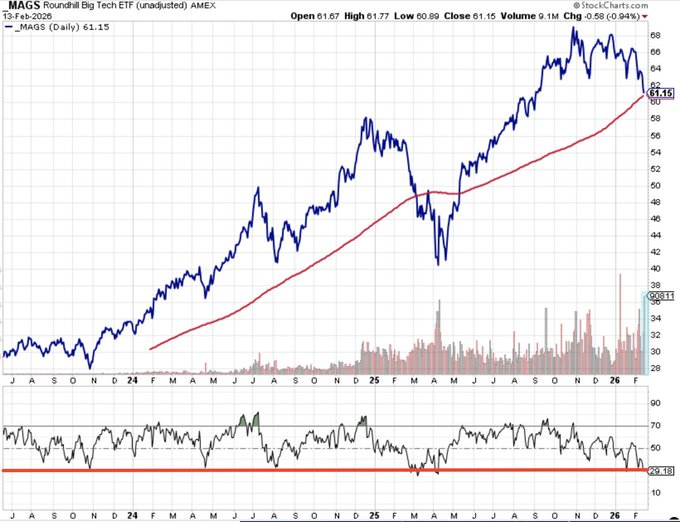
- AAPL down 8%; AMZN down 5.5%; GOOGL down 5.3%; META down 3.3%; MSFT up 4 bps; NFLX down 6.5%; NVDA down 1.2%; MU down 4.3%; BAC down 7%; C down 9.6%; GS down 2.5%; JPM down 6.2%; KRE down 3.2%; EUFN down 4.2%; SCHW down 10.8%; APO down 6%; BX up 13bps; KKR down 1.4%.
A big event has been the rout in “affection” for Mag 7 or hyperscalers relative to the broad market. Investors have loved the old love meaning stock buybacks from this crowd. They feel jilted to see corporate cash going to the opposite spectrum at the expense of buybacks.
- Mike Zaccardi, CFA, CMT 🍖@MikeZaccardi – GS: Hyperscaler capex spending plans surprised to the upside once again this earnings season, at the expense of buybacks.

And,
- Mike Zaccardi, CFA, CMT 🍖@MikeZaccardi – GS: We expect the increasing scarcity of free cash flows and buybacks will strengthen the premium for companies focused on returning cash flows to shareholders. Hyperscaler capex is on pace to reach 92% of cash flows in 2026

Witness $AMZN
- Mike Zaccardi, CFA, CMT 🍖@MikeZaccardi – $AMZN down 9 days in a row… longest losing streak in 20 years.. 23% drawdown

What about Operating Cash flow, you ask? Why don’t we let a smart guy answer?
Saperstein’s first point was that they are using the “dislocations” (fancy word for selloffs) to sell their long municipals exposure to buy the Mag 7/tech stocks & get exposure to the sector. Then his comments focused on Hyperscalars:
- “LOOK AT THE HYPERSCALERS. FOUR OF THEM GOOGLE, META, AMAZON AND MICROSOFT. THEIR CASH FLOWS ARE INCREASING AT AN INCREASING RATE. THE MARKET NOW IS PRICING FREE CASH FLOW NOT OPERATING CASH FLOW. SO THE MARKET IS SAYING, HEY, YOU’VE GOT THIS HUGE OPERATING CASH FLOW. WE
DON’T WANT YOU REINVESTING IT BACK INTO THE BUSINESS,”
He added ” In spite of such constraints, the hyperscalars are starting to allocate to their primary services; their 1st party services vs. 3rd party services. ” These hyperscalars have 3 choices:
- buy back their own stock, pay dividends, or
- reinvest back into the business, or
- put it on their balance sheet at 3.5%.
So Saperstein said:
- ” if you are a short term investor, you want to be in non-tech names for the most part. If you are a long term investor, you want to use this opportunity to add to some of these names. They are just building their infrastructure out for returns down the road. The key to follow all this is to follow the operating cash flow.“
He added, If these stocks were going up and the OCF was NOT, then he would be concerned. But he would rather own these stocks for the long term. Others should own Oil, Pharma, Banks for near-term performance.
2.3 Key Financials:
- BAC down 7%; C down 9.6%; GS down 2.5%; JPM down 6.2%; KRE down 3.2%; EUFN down 4.2%; SCHW down 10.8%; APO down 6%; BX up 13bps; KKR down 1.4%; XHB up 3.5%; ITB up 4%; NAIL up 11.8%
Larry Tentarelli @bluechipdaily highlighted the obvious & huge difference between regular financials & homebuilders describing his chart below as “Homebuilders breaking out while financials are breaking down below the 200-sma“

Since we prefer triple-leveraged SOXL to SMH, triple-leveraged TMF to TLT, surely we prefer triple-leveraged NAIL to ITB/XHB:
- Jason Leavitt, LeavittBrothers.com@JasonLeavitt – 2-10 – $NAIL giving it a shot

As we recall, Mr. Leavitt was the one who highlighted a breakout in SOXL in mid 2025 as it crossed $19.18. Given the stunning rise in SOXL since his call, we would be thrilled if we get a puny 25% in the NAIL. Remember the 14th century proverb – “for want of a Nail, the kingdom was lost“!
Now to the negative side of performance by big financials:
- Mike Zaccardi, CFA, CMT 🍖@MikeZaccardi – $XLF ugly… looking all head-n-shouldery, below 200dma, weakest RSI since last April

2.4 Dollar, Commodities & International Stocks:
Dollar was down 70 bps on UUP & down 79 bps on DXY:
- Gold up 1.5%; GDX up 6.7%; Silver up 7.7%; Copper down 1.9%; CLF down 29.5%; FCX up 73 bps; MOS up 3.7%; Oil down 1.3%; Brent down 56 bps; OIH up 3.9%; XLE up 2.1%;
International Stocks:
- EEM up 1.8%; FXI down 2.3%; KWEB down 4.4%; EWZ up 1.3%; EWY up 7.4%; EWG up 1%; INDA down 73bps; INDY down 1%; EPI down 1.1%; SMIN up 37 bps;
2.5 Treasuries & Interest Rates:
- 30-year Treasury yield down 15.1 bps on the week; 20-yr yield down 16.3 bps; 10-yr down 15.6 bps; 7-yr down 16.2 bps; 5-yr down 15.1 bps; 3-yr down 12.3 bps; 2-yr down 9 bps; 1-yr down 2.5 bps;
- TLT up 2.5%; EDV up 3.8%; ZROZ up 4.3%; HYG up 5 bps; JNK up 8 bps;
A timely call on Tuesday, Feb 10:
- Trader Z@angrybear168 – 2-10 – $TNX daily 8/21 bearish cross, finally time for yields to fall? bear flag measured move target at previous low.

Even more timely was Einhorn’s call on “substantially more than 2 rate cuts” on Wednesday morning when rates were up hard due to misconceived impressions from the Jobs Report that morning.
3. Is Software the new Commercial Real Estate? Extend & Pretend – I
Remember when housing was so solid, so comforting & so symbolic of rock-hard stability! Then debt was poured on it & valuations went sent flying high. Then the incoming money flow began to recede & you know what happened – nudity was exposed to use the Buffet analogy.
Yeah, but we all know how & why that happened. But that can’t happen to software, right! A software company is run by smart people & without liabilities. That is why software has always received much higher multiples than homebuilders. And still, software only makes up 3% of the high-yield market. No problem! Even the broadly syndicated loan market has only 13% in loans to software companies – not good but not critical.
That brings us to the new innovation & the wave of credit it has unleashed on the software sector. Bruce Richards of Marathon said on CNBC this week that software accounts for 23% of the Private Credit space, either as private BDC, public BDC or direct lending fund. What has that done to the software space?
- “software companies used to trade at 20 time PE multiples; … then Private Credit stepped in with 9-10 turns leverage and provided debt financing“.
But now, as Bruce Richards explained,
- “with public markets going from 30 to 15 multiples, private credit in the PE world has seen multiples contract from 20 (nothing has traded) to probably around 10 times which means how much debt should these companies have? 4-5 turns! “
So who is going to extend that next loan? NOBODY answers Bruce Richards and says “Extend & Pretend is NOT a strategy“!!! And he adds “It’s going to be a big huge reckoning“!
One result already is that exposure to Software has become the new untouchability. As Bruce Richards said, the #1 question anyone is going to ask is “how much software exposure do you have as a lender?”
But, as Bruce Richards said, “Its going to get a lot worse because we haven’t seen anything really collapse yet; its going to take some time to play out” .
Makes perfect sense, right! After all, valuations really start falling when the collapse begins & fear explodes. Because that is because you can’t Pretend when you become unable to Extend:
Bruce Richards added: ““there are going to be 3 types of companies:
- software companies that are going to prosper from AI; creative destruction makes them stronger;
- those that have a kind of moat that is being encroached upon but will survive;
- those that are having a difficult time & probably don’t survive this big development that is happening”
Now think back to similar situations in the past and realize what happens to interest rates when “the collapse begins“. There is only one harbor where people run to safety – US Treasury market. Is that what happened on Thursday & Friday of this week?
4. Vibesession, Not a Recession; Losses are NOT permitted! Extend & Pretend – II
Below are views of an expert whose breadth & depth of understanding of the US consumer & the US economy is beyond what we know or even can imagine. Lakshmi Ganapati, the Head of Unicus Research, is the only one of Indian origin whom we would listen despite the mispronunciation of her semi-sacred first name (Not Laaksmi, Mr. Eisman, but Lakshmi with the “a” sound).
She tells us that the consumer (esp. the lower K consumer) is cracking but staggering efforts are being made to prevent that. And the key to that is absolute refusal to take losses by the lending & asset management community, the key being EXTEND.
The term vibe session is pretty much the disconnect between what’s appearing in the data and how people are consumers are feeling. One example is the term Modifications:
- Modifications is you buy a car and then you’re wanted to pay five, you’re supposed to pay $500 a month for the car and the consumer comes back and say, “Hey, can you please have my car back? I don’t want it because I can’t pay 500. I can’t pay $500. I can’t pay 500. So the bank for instance, Ally, we heard from our wholesale sources is that hey, you know, we don’t want her to take your car back. So pay 400. Pay for how much can you pay? Right? And it’s like, Pay for how much can you pay? Right? And it’s like, okay, you can pay 100. Fine. I will extend the term of the loan, right? So, in other words, instead of having a make up a number, three-year loan where you pay $500 a month, you’ll pay $200 a month, but it’s not a three-year loan. Now, it’s a seven-year loan. Seven-year. Yeah. …. There is a hundred month car loan. 100 months. A 100 month car loan!
Isn’t such “modification” preferable to booking a loss? Yes because the Modification preserves the asset backed securities business.
Then you have the famous term – Buy Now, Pay Later (BNPL). It was designed as a bridge between the time they receive the paycheck to the time they receive the other paycheck. What has it morphed into?
- “according to the latest statistics 19% of BNPL users forget that they have money to pay. They forget that they forget. They forget. Yeah. because they have like so many BNPL. You can BNPL Rent right now. You can BNPL Door Dash right now. So you can BNPL um Amazon. So if you BNPL so many things if you don’t have an Excel sheet to track they forget 19% of because you’re getting BNPL from different issuers different CLA …. “
That is the story in commercial real estate too:
- “if someone’s loan is coming due yes and the original loan I’ll just make up a number was paying 5%. But today if they were going to refinance they’d have to pay 10. Yes. Then they would declare bankruptcy. The bank would just say okay just keep paying us five. Keep going. That is perfectly fine because we are in a situation across the board that nobody wants to show losses in their books because it’s like a house of cards if one person shows it and then the other person have to you know check their books and they have to show it. So everybody is extending and pretending and the regulators are letting them do this.”
How detailed is the discussion in the clip? Just look at the table of contents:
- 00:00 – Intro 01:34 – The Health of the US Consumer 08:35 – Is There Already a Recession? 16:02 – Problems with Carvana & the Used Car Business 20:58 – Commercial Real Estate 25:56 – The Yen Carry Trade 30:10 – FICO 33:56 – Digital Realty 37:39 – GE Vernova 39:37 – Private Credit Concerns 43:25 – The Problem with the US Consumer Today
What surprised us was the section on Data Centers – the theme that AI depends on:
- “The entire data center business model is quietly collapsing. And what I mean by that is there are nearly 25 to 30 projects that were cancelled last year and it did not hit the mainstream media. And why were they cancelled? Because of the push back from the neighborhood because of the electricity cost are going up 30%. We sent out an investigator in Virginia where you see an entire county filled with data centers, right? and they pay as x amount of money to the county but nothing goes to the people who live there. The electricity cost is 25 to 30% up and we are hearing that the data center somehow the water is being sucked out from the nearby wells and people property. So this is getting a huge push back and it’s becoming a political issue. So a lot of data centers are getting quietly cancelled.”
What’s the summary?
- “The problem with the US consumer is that the invisible cost have gone so up and invisible cost in like in what in health insurance invisible cost in maintenance of a car invisible cost in term and the wage growth hasn’t kept up with the expenses that they are enduring and it doesn’t matter whether the student loan garnishment has been paused right it does job matter. They don’t; the money that they are making is not enough to live in a very decent manner. Okay. So, you’re basically saying a very high percentage of the US consumer is stressed. Very stressed.”
Eisman asked – “Even though it’s not really yet showing up in the credit data, but you think it’ll show up maybe second half of this year”
- “if not next year. the second half this year would we will see the cracks coming up because the consumers are stretched thin when they are stretched thin they will start to cut the expenses …. maybe I don’t want a car maybe I’ll take a bicycle and go so that kind of um … the first canary in the mine would be deterioration in consumer spending “
Is this an economy, is this the majority of Americans, whom the Fed should punish by emphatically keeping interest rates high to satisfy their own inner cravings of neo-Volkerism? By the way, isn’t that what Bernanke did in 2008?
It took the Fed 2nd half of 2008 to recognize the disaster & begin cutting rates fast. We at Macro Viewpoints are forward-view analysts & so we decided to cut rates today.
Send your feedback to editor.macroviewpoints@gmail.com Or @MacroViewpoints on X.
