Summary – A top-down review of interesting calls and comments made last week in Treasuries, monetary policy, economics, stocks, bonds & commodities. TAC is our acronym for Tweets, Articles, & Clips – our basic inputs for this article.
Editor’s Note: In this series of articles, we include important or interesting Tweets, Articles, Video Clips with our comments. This is an article that expresses our personal opinions about comments made on Television, Tweeter, and in Print. It is NOT intended to provide any investment advice of any type whatsoever. No one should base any investing decisions or conclusions based on anything written in or inferred from this article. Macro Viewpoints & its affiliates expressly disclaim all liability in respect to actions taken based on any or all of the information in this article. Investing is a serious matter and all investment decisions should only be taken after a detailed discussion with your investment advisor and should be subject to your objectives, suitability requirements and risk tolerance.
1. Markets Last Week
1.1 US Indices:
- VIX up 24.8% to 18.77; Dow down 93 bps; SPX down 1.3%; RSP down 43 bps; NDX down 4.1%; RUT down 54 bps; MDY down 16 bps; XLU down 53 bps; SMH down 8.9%; SOXL down 29.5%
Semiconductors have seen a virtual bloodbath recently but who would notice it if one “zooms out” to use a Warren Pies expression:
- Bespoke@bespokeinvest – Biggest selloff for semis since the tariff tantrum, but it still barely registers relative to the rally since then. $SMH

And Pies used a different chart to make his point:
- Warren Pies@WarrenPies – – One interesting change in market structure during the AI era has been the negative correlation that so many non-tech stocks have with semis. Purple line of the chart below plots the 10th percentile of non-Tech S&P 500 stocks correlation to semis. Most negative its ever been

Below are his comments on CNBC Closing Bell on Friday with @thedomino or Dominic Chu.
- “I think when you zoom out that, we have had a nice rotation, a nice reset from the momentum trade that carried us until July & that momentum has been synonymous with Semis & with hardware”
- “our base case is that this lasts for a couple of weeks or so but when you zoom out, this will be perceived as a good buying opportunity“
- “this morning was sell everything kind of a wave & makes sense to see Semis & the memory names start to come back later in the day …”
Watch & listen to the clip below for more discussion:
Timing is everything, right! For example, witness the ebullience of Larry Fink on Wednesday morning before the Thu-Fri drama:
- “I believe the role of financing the structure around technology, whether it is financing data centers, financing the purchase of chips, as I said earlier, we are going to have markets investing in compute, we are going to have a futures market in compute; this is going to be the next revolution in finance and it happens because of the strength of the United States Capital Markets, having the ability to finance these new technologies; the United States & other places in the World are leaders of the new technology”.
Ok, but what should simple folks be doing now?
- Mike Zaccardi, CFA, CMT@MikeZaccardi – BlackRock: Our highest conviction view, July 2026

All that is fine, but what about an indicator for investor positioning?
- Mike Zaccardi, CFA, CMT 🍖@MikeZaccardi – 7-19 – GS US Equity Sentiment Indicator of investor positioning… remains nicely positive, but not too high

1.2 MAG 7:
- AAPL up 5.8%; AMZN up 77 bps; GOOGL down 2.9%; META down 3.5%; MSFT up 2.3%; NFLX down 6%; NVDA down 3.9%; MU down 13.3%; IBM down 26%; IGV up 42 bps; CRM up 4.6%; PANW up 10.1%; NOW down 4.2%
Interesting question below:
- The Market Ear@themarketear – Mag 7 vs SOX – Mag 7 rising while SOX falls. Will we soon get the announcements that Mag 7 is about to scale back capex spending?

This week featured both the fabulous & the other extreme. The difference between them was described simply by the folks from Beat Report who sent us their opinion on the contrast:
- “Goldman has strong technicals, strong fundamentals, and improving earnings sentiment.”
- “IBM has weak technicals, weak fundamentals, and terrible earnings sentiment.“
Then they elaborated on IBM:
- IBM reported $17.2 billion in revenue, up just 1%, with Software revenue up 5%, Consulting roughly flat, and Infrastructure revenue down 7%.
- Management said the shortfall was driven by weaker-than-expected performance from its software business, along with large deals that failed to close on expected timelines.
- As a result, the stock fell more than 25% for IBM’s worst day ever.
- Worse than Black Monday in 1987…
- Worse than anything we’ve ever seen!
- And now the chart is sitting right on top of a very important support zone near $212.
- If buyers fail to defend that level, it would mark the resolution of a massive top and the beginning of a brand-new primary downtrend.
- For now, the bulls are holding on for dear life at $212.
For a more analytical perspective, watch-listen to the clip below of Brent Thill of Jeffries discussing the 3 factors that impacted IBM’s stock.
- (min 1:20) “its unclear speaking to them whether these deals rebound in the second half of the year…”
- (min 1:39) – “I think this is more IBM specific that it is a software industry issue”
We will share our own sentiments about this mess at IBM in Section 2 below.
1.3 Key Financials:
- BAC up 2.7%; C down 8.1%; GS up 95 bps; JPM up 1.4%; KRE up 2.2% ; EUFN up 2 bps; SCHW down 1.5%; APO up 11 bps; BX up 3.1%; KKR up 4.1%; XHB down 33 bps; ITB down 44 bps; NAIL down 2%; IGV up 42 bps; CRM up 4.6%; PANW up 10.1%; NOW down 4.2%
After the above praise of financing from Signor Fink, we have to include at least one recommendation from a smart guy about a financial, right? Guess what Info@allstarcharts.com put out but use at your own risk:
- The index is made up of six of the largest banks in America: JPMorgan Chase $JPM, Goldman Sachs $GS, Morgan Stanley $MS, Citigroup $C, Wells Fargo $WFC, and Bank of America $BAC. When institutions this important continue making new highs, it’s difficult to build a convincing bearish case for the broader market. Of the group, Bank of America stands out to me from a risk/reward perspective. The stock is breaking out of a two-decade base, clearing the highs from the Great Financial Crisis around 55. That’s nearly 20 years of overhead supply finally being absorbed. … For the first time in nearly two decades, every investor who bought Bank of America during that entire period is in the green. …. History tells us that breakouts from bases this large often lead to trends that last much longer, and travel much farther, than most investors expect.

1.4 – Dollar & Metals
Dollar was down 21 bps on UUP & down 24 bps on DXY:
- Gold down 2.4%; GDX down 5.6%; Silver down 6.2%; Copper down 89 bps; CLF down 1.3%; FCX down 5.1%; MOS up 2.9%; Oil up 14.5%; Brent up 15.2%; OIH down 33 bps; XLE up 4.7%; PBR up 3.8%;
A view on Copper vs. Nasdaq:
- Otavio (Tavi) Costa@TaviCosta – 7-18 – The Copper-to-Nasdaq ratio is on the verge of a major breakout. I’d rather own the irreplaceable materials powering AI than chase tech companies priced for perfection. https://tavicosta.substack.com/p/the-real-ai-

1.5 – International Stocks:
- EEM down 5.4%; FXI down 2%; KWEB up 1.6%; BABA up 2.4%; EWZ down 2%; EWY down 11.4%; EWJ down 3.3%; EWG down 80 bps; INDA down 79 bps; INDY down 16 bps; EPI down 70 bps; SMIN down 1.8%; IBN up 2.6%; HDB down 49 bps;
Forget Asia & focus on Europe?
- J.C. Parets@JC_ParetsX – European bank stocks just had their highest weekly close ever

To their credit, the JCP-team had highlighted EUFN a little while ago as it broke out. Kudos to them.
A broader comment came from Max Kettner of HSBC. He used descriptions like a “pretty bullish mix” & overall still constructive” & that too at the end of the turbulent week. Why is this a pretty bullish mix?
- “Fed is not going to get more hawkish; minimal recession risk; tech correction is mainly positioning & Oil is not going to spike much here”
And he says “overall nothing has happened right?” His point:
- “when you look at global equities, you might feel things have sold off 10%-15% but overall, DM equities are off 1/2% of all-time highs“
He does point to Japanese Banks falling 5% on Friday and says “that doesn’t make a lot of sense” & says “it smells like liquidation“.
But what about Semis? He says:
- “some of the positioning stuff, particularly when it comes to Semis, is already flashing a buy-signal” … that really keeps us overall still constructive“
1.6 Treasuries & Interest Rates
- 30-year Treasury yield up 0.7 bps on the week; 20-yr yield up 0.1 bps; 10-yr down 1.2 bps; 7-yr down 1.9 bps; 5-yr down 2.6 bps; 3-yr down 2.8 bps; 2-yr down 2.7 bps; 1-yr down 6.1 bps;
- TLT up 6 bps; EDV down 11 bps; ZROZ down 39 bps; HYG down 8 bps; JNK up 5 bps; EMB down 48 bps
Once again, we quote the “unrosie”:

Rosenberg wrote in his recap:
- “The starting point for real GDP growth, as per the Atlanta Fed, is barely better than a stall-speed +1.5% annual rate. Not a very big cushion at all. The U.S. economic surprise index shifted back into negative terrain a month ago, led lower by housing and the labor market. The FIBER leading economic index has rolled back to where it was last March. Best for equity investors to check the cyclical exposure they have in their portfolios.”
Add to the above, his addendum about labor market:

2. IBM – an emotional & personal view
We knew little about Arvind Krushn of IBM before we got to know his public & contemptuous pronunciations of Bhagvaan Krushn’s name. Born obviously of devout & intellectual parents, Arvind seems to revel in insulting the revered name by pronouncing it Krishnaa meaning dark-skinned woman. Frankly, we are not even sure he did it out of some contempt towards the Lord. In fact, we believe he will say that he says it the way many many devotees do. But no one would use that excuse when horribly mispronouncing Jesus or Mohammed.
In our humble opinion, Arvind like many others deliberately mispronounces the name just to fit in with pro-British elite who have contempt for Hindu Dharma & its history. Had he done in privately among his elite friends, that would have been one thing. But he chose to insult Bhagvaan Krushn publicly using the megaphone of IBM’s Board of Directors. That is a very different thing.
The vast majority of readers may not be aware but it has been fashionable since 5561 BC for some to publicly insult Bhagvaan Krushn and do it with relish as a major accomplishment. And since the days of Shishu-Paal, the first king to do so with deadly consequences, such abuse of the Lord has almost always resulted in very substantial punishment for the arrogantly hateful.
Knowing this, we did not fall for the adulation of this Arvind fellow by CNBC & others. We stayed away from him and his stock. So when we heard & saw the atrocious debacle in IBM shares, our first gut reaction was “serves him well“. The trouble was that Arvind alone did not suffer but he took down all IBM shareholders & many others with him.
Allow us to state that we are NOT highly religious. Actually we don’t pray much or go to temples and such. But we understand that there are things beyond our ken. And we know from history how the Krushn haters end up unhappy & hurt. So we stayed away from IBM stock.
There is another key point about Arvind. He seems to have been focused on appearing on US TV. To get on it, we saw him literally beg anchors when, as Chairman of IBM & having achieved his “high” stature, he should made them beg to invite him. We did wonder why. One thought is that like thousands of white-bootlicking Hindus, he wanted their acceptance and invitation on CNBC. The other thought is he knew himself that his public reception might not be durable because, conceivably he knew himself that IBM’s results were not long term enough.
That brings us to CNBC and, particularly Ms. Sara Eisen. As we recall, Ms. Eisen said on Friday morning that “Arvind told me” or “Arvind said to me” or a phrase to that effect. She didn’t say Arvind said to CNBC or Arvind’s explanation was or words to that effect. Did she want to highlight on CNBC’s air that Arvind spoke with her, the “her” being the point of emphasis and not what Arvind said? And if she did so, is that common behavior with CNBC Anchors?
To put it simply, we just did not trust Arvind (with a female pronunciation Krishnaa) to put our monies in IBM stock especially after we witnessed what we perceived as his desperation to be on CNBC. Interested readers should check our article dated November 9, 2025, Section 4 titled Israeli Jews & Hindus in contrast to Some US Jews & Hindus – 2 examples. It is a long section on this topic of anchors like CNBC’s Sara Eisen almost contemptuously using the feminine Krishnaa for Arvind and Arvind, pathetically in our opinion, allowing her to do so.
In the same article, we point out that CNBC’s Sara Eisen has never, to our knowledge, feminized the name of Shyam, Palatir’s CFO, as Shyama as she does with Arvind’s last name. Look at the two clips of Arvind of IBM and Alex of Palantir with Sara & see if you agree with what we wrote on November 9, 2025:
- “Watch Ms. Eisen’s two interviews above and see if you can notice any difference between the power level between Alex Karp & Ms. Eisen and the power level between Arvind Krishna & Ms. Eisen. Our own feeling, as we watched the two interviews live, was that Sara Eisen was the lower power figure seeking feedback/answers from Alex Karp while Arvind Krishna was the lower power figure thanking Sara Eisen for the privilege for allowing him on CNBC’s air.“
You know it usually works out when you trust your gut reactions. Arvind & IBM Stock were flying on November 9, 2025 (around $309/-) when Sara Eisen treated him & OUR Religion as pathetically weak. But for Arvind’s own contempt for correct pronunciation of Krushn &, what we felt, was Eisen’s contempt for our religion, we might have bought IBM stock at around $309/-.
It closed Friday at $212.67. So this may be one time & the only time so far that we thank Sara Eisen. Her contempt for Bhagvaan Krushn saved us $97/- per share.
But, once again, history proves correct. Stay away from those who insult Bhagvaan Krushn!
By the way, the above does not mean that the feminine name Krishnaa is not great or famous. Watch the last 3 minutes of the recent clip below in which her brother Drushtra-Dyumna & Krishnaa come out of the mantra-created fire. The woman born out of the fire is of darker complexion, a rarity at 5530 BCE in India and so the sages name her Krushnaa, the dark one. History tells us that she was a woman that no man could look at & not feel carnal thoughts. The thought that this Arvind of IBM can dare to call himself as the name of this celestial woman is sacrilege in itself.
Seriously watch the clip below from 20:00 min to 23:40 min. The actress who plays the part is attractive no doubt, but nothing compared to the Krishnaa who was born out of the Sacred Fire. Watch as her form comes out of the fire as waves of light that slowly conform to her figure.
This is a gorgeous & opulent series. But in the interests of global reach & revenue, the English Pronunciations of the names are in the British style of feminizations. They may call her father Drupadaa instead of Drupad but they call her name Krushnaa correctly.
Krushnaa became a major part of events leading to the great Mahaa-Bhaarat war in which over 3.9 million warriors were killed in 18 days. The weapons were distance-weapons of enormous power that reminded Oppenheimer of his Atom Bomb explosion.
Now you understand why the feminization of Krushn by Arvind evokes such outrage. By the way, it is interesting to note that Scott Wapner, used the emotions of the fall of IBM to fulfill his inner hatred by pronouncing Krishnaa. What is in the water at CNBC that they can create such contempt?
In any case, Nov 9, 2025 was one day when Arvind’s & Sara’s feminization of Krushn saved us from losing $97/- per share of IBM stocks. Thanks to both.
3.Geo-Sphere
Two weeks ago, we wrote about the big new initiative by India & Japan to build a closer economic & defense relationship. To us, it was a huge breakthrough and we highlighted that in Section 3.1 titled India-Japan or Elder Brother & Younger Sister in our article dated July 5, 2026.
Then we described the 2nd part of Modi’s outreach to the Indo-Pacific in our article last week in 3 sections:
- Section 2.2 Malacca Straits & India-Indonesia ,
- Section 2.4 Modi in Australia “from Chips to Ships” and
- Section 2.5 India & New Zealand – “Get on plane …go Learn Indian Consumer“
The above are kinda detailed with supporting videoclips from Media & presentations by Asian Leaders. But its import goes far beyond Asia. For one, it has a very importing benefit to America as we explained in some detail in Section 3 3. Global Geo-stuff of our July 5 article. It applies Prof. Mearsheimer’s view that a global power committed to “maintaining global primacy across every region simultaneously” ends up in slow erosion of relative power compounded by strategic overreach.
As we wrote then, that Mearsheimer maxim doesn’t apply to America but applies very well to China instead. We explain that in the above quoted Section 3 3. Global Geo-stuff in our July 5 article.
Given the above, we were happy to see George Friedman of Geopolitical Futures come to a similar conclusion via his article A Major Move by India on July 13, 2026. Below are some excerpts from the Geopolitical Futures article, especially a quote from George Friedman in his related videoclip. We use that quote as a superb title for our next section.
3.1 “A God-send … from America’s point of view“.
The GF article also uses a superb graffic that visually makes the point of the new Indo-Pacific initiative of Modi-Takaichi-Philippines-Vietnam-Indonesia-Australia-New Zealand. It is an initiative that achieves America’s basic Indo-Pacific initiative without any responsibilities or costs for America.

Excerpts from the GF article:
- This month alone, Indian Prime Minister Narendra Modi has visited Japan, Indonesia, Australia and New Zealand. He reached agreements on economic cooperation and, more importantly, on defense cooperation. Several months ago, the Vietnamese president visited India to discuss similar matters and strengthen existing security ties.
- The economic dimension of these agreements between India and Australia, Indonesia, Japan and New Zealand, assuming they evolve, creates a very powerful economic bloc and a potentially powerful military barrier to China’s access to the oceans. That the Philippines, which is still firmly in the U.S. camp, lies between Japan and Australia adds to Chinese obstruction.
- From the U.S. point of view, this evolution in Asian relations – again, assuming it evolves – relieves the U.S. from the need to be the primary force containing China. The emerging network would threaten China on land from India and Vietnam and, in theory, impose a naval blockade of sorts. Though the threat to China may never fully materialize, China can’t afford to ignore it.
- A new network of alliances would also give Washington more economic leverage over China. China’s economy produces more products than it can domestically consume. It therefore must export massive amounts of its goods to maintain its economic health, and its largest customer is still the United States. The massive economic power of the nations in this potential coalition could be an alternative source for the U.S. to access imports.
- Bear in mind that India is a member of the Quadrilateral Security Dialogue, often called simply the Quad, which also includes the U.S., Japan and Australia. This new coalition, which Modi’s recent behavior suggests is looming, is far more significant than the Quad – not only because it has an economic dimension but also because it includes Indonesia, which could further weaken and potentially limit China’s maritime access to Europe and the Middle East. This would make China dependent on a trans-Pacific route through the Panama Canal or around South America.
- …. what Modi seems to have achieved is a historical event.
In our view, the inclusion of Japan via its bright, focused & independently minded Prime Minister is an important a factor. Japan, especially with Taiwan, can create naval hindrances, if not a full blockage of Chinese Navy into the Pacific.
In the context of Friedman’s article this week, take a look at the clip below that looks at the three countries that sit on China’s naval pathways & have acquired India’s supersonic missile Brahmos. The clip below is visually quite helpful though mischievously titled India Arms China’s Neighbours With BrahMos, Beijing Faces Missile Ring.
The turn in George Friedman’s views about India might actually be greater than the actual turn discussed above. Since his Stratfor days, Friedman has brushed aside India’s role saying that India can’t amount to anything without solving its “Muslim” problem. Then last year he published a clip titled “India is just a Pawn” essentially between Trump’s America & Xi’s China.
Every one has their blind spots. And Friedman’s blind spot is Turkey. Several years ago, as we recall, Friedman labelled Turkey as the next Superpower. That still remains a joke even though Turkey is the strongest power at Asia’s other extremity. This is not the time or the place to discuss Turkey but the world has to change BIG before Turkey becomes a super-power. On one hand, Turkey faces Iran & Afghanistan while on the other hand, Turkey faces Saudi Arabia & NaPakistan, Saudi’s new hired hand. And if any fear sort off drives Saudi Arabia & Iran together with Israel, it is Turkey.
3.2 China & NaPakistan vs. India – Political Issues & Military Implications
There are two geographical nodes of CPEC – China Pakistan Economic Corridor. One that ends in Gwadar in Balochistan & the other that begins in NPOK – or Na-Pakistan Occupied Kashmir. Today both nodes have caught fire. CPEC in Balochistan begins at Quetta in the map below & ends in Gwadar

3.2.1 Balochistan
It is easier to see the political problem with a state map, not just a map of states but a map showing the segregation of 4 different racial groups, one dominant in each state.
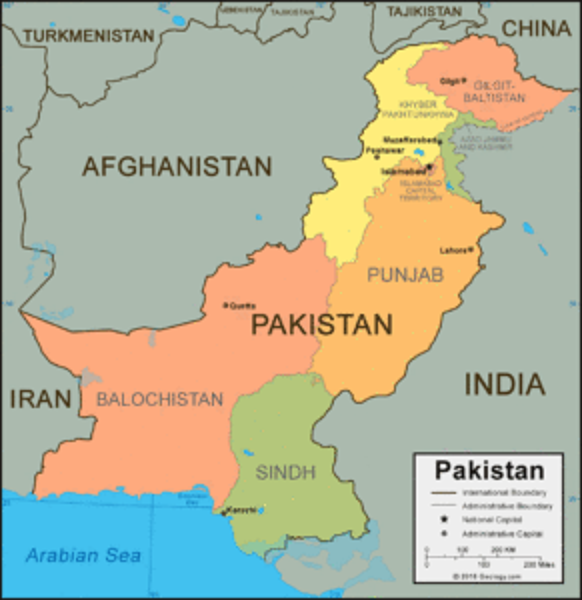
As you can see Balochistan, the province of the Baloch, is the largest physical province in NaPakistan. But it has only 15 million people out of Napak’s 250 mm total population. China extended huge amount of loans to the NaPak Panjabi government located in the Punjab province bordering India.
Now focus for a moment on the yellow Khyber-Paktunkhawa (KP) province, the province of 41 million Afghans in NaPak bordering Afghanistan with Peshawar as their capital. Forget about it. That province is almost semi-independent and has ordered the Napaki army & the Napaki police to stay out of it. Notice the main road goes thru Panjab to the right of KP and then in the south turns westward to enter Balochistan.
People of Balochistan have been fighting & demanding its independence from Napakistan. Just a couple of days ago, the Balochi Liberation Army killed 45 Napaki soldiers on the southern highway from Quetta to Karachi. Watch the CNN-News 18 clip below for a detailed & sensible clip carefully laying out the situation including Chinese interests & investments.
After that & the utter inability of the Napaki Army to do anything about it, the Balochis took the next & final step.
Balochistan, thru its leader Mir Yar Baloch, declared the Independence of Balochistan from Pakistan.
Frankly, Munir & his military have washed their hands off Balochistan long back. So they don’t privately care. That makes China the biggest loser. So real question is whether China help Munir & his army? The first bombshell from China has hit already:
A big Chinese venture in minerals has already said “We’re done“. And, as we read, China is putting pressure on Napakistan to return $10 billion they borrowed from China. So they turned to Saudi Arabia for a loan to repay the Chinese loan. It is reported that Saudi Arabia has refused to loan the money to NaPakistan.
3.2.2 Napak-occupied Gilgit-Baltistan & parts of Kashmir
Now we ask you to move diagonally towards the North-eastern red area called Gilgit-Baltistan, an area illegally occupied by Napakistan for decades. And below that is a small green strip called Napak-occupied Kashmir.
Frankly, folks, this is physically tiny compared to Balochistan & tiny in population too. But it makes it up in massive, emotional protests to break out of Napaki illegal occupation. For Munir, Balochistan getting out of NaPakistan is one thing but NPOK & Gilgit-Baltistan getting out is emotionally gut-wrenching for them.
This week, the Munir-army stopped relying on local police who proved to on the side of protestors. So the Munir-army sent in 8,000 Rangers of the NPak-Army, two days ago, apparently with orders to shoot & kill protestors.
Then just as we write this today, Sunday July 19, we saw the news that
- “The United Nations has called for an independent and impartial investigation into reports of alleged civilian deaths and human rights violations in Pakistan-occupied Jammu and Kashmir (PoJK). The appeal comes amid growing international attention over the reported incidents and renewed calls for accountability, transparency, and protection of civilians.”
But we urge that a high degree of caution be used in understanding the unfolding events. The clip below features Maj Samar Pal Toor (Retd), who explains the need to be careful. He states that the relationship between the ISI (the infamous Napak military intelligence) and Munir’s Army has reached an all-time low. He also suggests that Lashkar-e-Taiba (LeT) and Jaish-e-Mohammad (JeM) have inserted modules in civil clothes to manipulate the public narrative about the protests. If interested, listen to Major Toor in the clip below. If nothing, it will beat any spy-mystery novel you might have read.
The funniest part of this entire saga is that Munir-Shahbaz combo is spending their time & effort in Saudi Arabia & declaring a Red Line of protection for Saudi Arabia while their own army is running away in their own homeland from unarmed protestors.
Send your request to editor.macroviewpoints@gmail.com Or @MacroViewpoints on X.
